
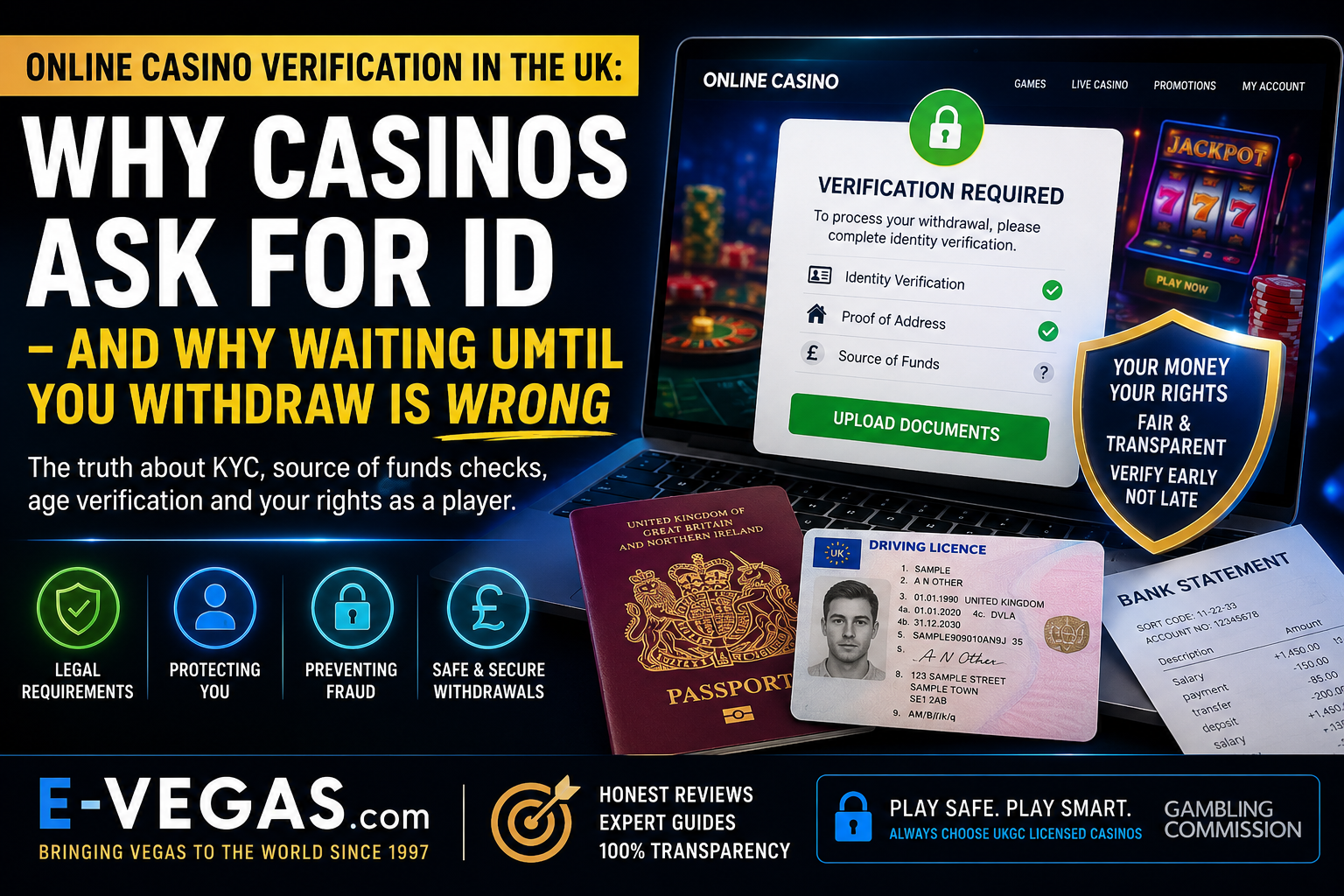
Online Casino Verification in the UK: Why Casinos Ask for ID and Why Waiting Until You Withdraw Is Wrong
Online casino verification is one of those subjects where two things can be true at the same time.
UK gambling companies have legitimate legal and regulatory reasons for knowing who their customers are. Casinos need to prevent underage gambling, identify self-excluded players, combat fraud, comply with anti-money-laundering requirements and understand where necessary whether the money moving through their platforms is legitimate.
Few reasonable players would argue that regulated gambling should operate without those safeguards.
But there is another side to casino verification that deserves considerably more scrutiny.
A customer can sometimes register with an online casino, deposit money and start gambling without ever being asked to photograph a passport, upload a driving licence, send a bank statement or provide a utility bill.
They may deposit several times.
They may play for days or weeks.
They may even make previous withdrawals successfully.
Then they win.
They request a withdrawal and suddenly encounter a message telling them that the payment cannot proceed until they provide documents.
That is the moment many perfectly legitimate customers become angry.
And it is not difficult to understand why.
From the player’s perspective, the casino appeared perfectly satisfied with their identity while money was travelling from the customer to the casino.
Only when money was due to travel from the casino back to the customer did verification suddenly become an obstacle.
That creates an appearance of unfairness that the regulated gambling industry should be doing everything possible to eliminate.
First, There Is an Important Misunderstanding About Casino ID Checks
When somebody says, “The casino let me gamble without verifying me,” that may not technically be what happened.
Modern online casinos can perform identity checks electronically.
The UK Gambling Commission explains that gambling companies can sometimes match customer information against existing databases, including credit-reference information and the electoral roll. If those electronic checks provide sufficient confirmation, the customer may never be asked to upload a physical identification document.
That means you can potentially open an account, enter your name, address and date of birth and begin playing without photographing your passport — while still having undergone an identity verification process behind the scenes.
This distinction matters.
The absence of an uploaded passport does not automatically mean that the casino ignored its verification obligations.
UK-regulated online gambling businesses are required to verify a customer’s age and identity before allowing that customer to gamble. The Gambling Commission introduced stricter rules in 2019 specifically requiring remote operators to verify, as a minimum, a customer’s name, address and date of birth before permitting gambling.
So the criticism should not simply be:
“Casinos take deposits without checking anybody.”
That would be too simplistic.
The much more important question is:
If a casino already knows that additional documents are going to be necessary, why should it be permitted to wait until a customer asks for their money before requesting them?
And interestingly, the Gambling Commission itself has already addressed precisely this issue.
The Gambling Commission Says Casinos Should Not Save Avoidable Checks Until Withdrawal
The Gambling Commission’s consumer guidance is remarkably clear.
It states that a gambling business should not ask a customer to prove their age and identity as a condition of withdrawing their money if it could have asked for that information earlier.
It also says that if additional information is needed — including information required for anti-money-laundering purposes — businesses should request it promptly rather than waiting until the customer wants to withdraw funds.
This is extremely important.
It means the basic principle behind the frustration felt by players is already recognised by the regulator.
If information could reasonably have been obtained before the customer deposited and gambled, there is little justification for allowing the customer’s withdrawal request to become the trigger for asking for it.
The Gambling Commission was concerned enough about this behaviour that when announcing its stronger verification rules in February 2019, it specifically mentioned complaints about operators requesting additional identity information when consumers attempted to withdraw winnings.
At that time, the regulator said around 15% of complaints received by its contact centre concerned licensees refusing withdrawals until customers submitted certain forms of identification.
That tells us this is not merely an irritation imagined by a handful of disgruntled gamblers.
It has historically been a significant consumer-protection issue.
If You Are Good Enough to Deposit, Should You Be Good Enough to Withdraw?
This is where I believe the industry needs to look at verification from the customer’s perspective.
Imagine walking into any other business.
The company happily takes five payments from you.
It supplies its service.
It allows your account to operate normally.
There is no indication that anything is wrong.
Then the business owes you money.
Suddenly it announces:
“Before we can give you your money, we need significantly more information from you.”
Even if there is a legitimate explanation, it is obvious how this looks to the customer.
It creates an asymmetric relationship.
When the financial direction benefits the operator, everything appears frictionless.
When the financial direction benefits the customer, friction suddenly appears.
That perception alone is damaging to trust in the online gambling industry.
Regulated casinos should be trying to demonstrate that deposits and withdrawals are treated with equal seriousness.
The principle should be extremely simple:
If information is essential before you are prepared to pay a customer, obtain it before you are prepared to take substantial amounts of money from that customer whenever reasonably possible.
There will inevitably be exceptions.
But the exception should not become the customer experience.
Why Casinos Sometimes Need More Information Later
There is an important counterargument, and it would be misleading to ignore it.
Not every verification requirement can possibly be completed at registration.
A player’s circumstances and gambling behaviour can change.
A person who initially deposits £20 may later begin depositing hundreds or thousands of pounds.
Transactions can produce unusual patterns.
Payment methods can change.
Information previously provided may become questionable.
An account may display indicators associated with fraud, money laundering or financial harm.
UK casino operators therefore have continuing responsibilities rather than a single verification obligation performed once when the account is opened.
The Gambling Commission’s anti-money-laundering guidance requires casino operators to perform customer due diligence and, depending on the circumstances, further monitoring and enhanced due diligence. Operators must identify customers and verify identity using reliable and independent information.
The regulations also create circumstances in which additional due diligence becomes necessary because of transactions, suspicions or concerns over previously supplied information.
This means a casino can legitimately know enough about you to allow you to open an account today yet subsequently require considerably more information tomorrow.
That is not inherently abusive.
It is part of running a regulated financial relationship in a sector particularly exposed to money laundering and fraud.
Source of Funds Is Different From Basic Identity Verification
This distinction becomes particularly important when people talk about “ID checks”.
There are actually several different forms of verification being bundled together under that phrase.
Basic identity verification establishes who you are.
Age verification establishes that you are legally old enough to gamble.
Payment verification may establish that a card, bank account or other payment method genuinely belongs to you.
Customer due diligence examines the wider relationship between the operator and customer.
Source-of-funds enquiries can investigate where the money being gambled originates.
Enhanced due diligence can go further where a higher level of risk has been identified.
These are not interchangeable.
A casino might therefore have successfully established that John Smith, aged 42, lives at a particular address before John ever places a bet.
That does not necessarily establish where £20,000 subsequently deposited into John’s casino account came from.
If circumstances later create legitimate anti-money-laundering concerns, asking additional questions can be entirely appropriate.
The Gambling Commission’s guidance expressly recognises that operators may consider information about a customer’s source of funds and legitimate income when determining whether gambling appears proportionate or suspicious.
This is why the argument cannot sensibly be that a casino should never request documents when a withdrawal is made.
Sometimes new information genuinely becomes necessary at that point.
The issue is whether the withdrawal genuinely created the need for further investigation, or whether the operator simply postponed a predictable check until the customer wanted their money.
Those are two very different situations.
The Customer Should Not Have to Guess Which Situation Applies
Transparency is where I believe considerable improvement is still possible.
A customer requesting a £1,000 withdrawal should not simply receive:
“Withdrawal suspended. Please upload identification.”
That tells the customer almost nothing.
Was the original electronic identity check unsuccessful?
Does the casino need proof of address?
Does it need to verify the payment method?
Has the customer’s activity triggered enhanced due diligence?
Is a source-of-funds assessment required?
Has the casino discovered conflicting information?
Is this merely a routine document request that could have been made days earlier?
The difference matters enormously.
A legitimate regulatory check presented without explanation can look indistinguishable to the customer from a casino deliberately making withdrawal difficult.
That is bad for players and bad for reputable operators.
Casinos Should Tell Customers About Potential Verification Before They Deposit
This is another area where regulation already supports the principle of greater transparency.
When the Gambling Commission introduced its strengthened verification requirements, it said operators should inform customers before they deposit about the types of identity documents or other information that may be required, the circumstances under which they could be requested and how those documents should be supplied.
That is exactly how it should work.
A customer should know before putting £100, £500 or £5,000 into a gambling account that certain circumstances could result in additional checks.
The operator should not bury this possibility somewhere on page 47 of terms and conditions that practically nobody reads.
It should be made clear.
For example:
“We have verified your identity electronically. Additional verification, payment-method or source-of-funds documents may still be required in certain circumstances.”
That single sentence would immediately make the relationship more transparent.
Why Do Withdrawals Trigger Checks So Often?
There is nevertheless a practical reason why withdrawals often coincide with verification.
A withdrawal represents a transaction.
Transactions can produce information that wasn’t previously available or significant.
A new bank account may be nominated.
A payment method may need ownership verification.
The amount being withdrawn may push activity into another risk category.
The overall deposit, wagering and withdrawal pattern may trigger automated monitoring.
An account may reach a customer-due-diligence threshold.
The Gambling Commission requires casinos to monitor customers where their activity indicates actual or potential money-laundering risk and to consider whether additional due diligence is necessary.
So “they only asked because I won” is not necessarily the complete picture.
From the operator’s systems, the triggering event might have been cumulative transactions, payment behaviour or some other risk indicator rather than the simple fact that the customer had won.
But operators need to recognise something important:
Customers cannot see those internal systems.
All the player sees is:
Deposit — accepted.
Deposit — accepted.
Bet — accepted.
Bet — accepted.
Withdrawal — stopped.
It should surprise nobody that this sequence generates suspicion.
The Industry Has a Trust Problem When Money Flows Only One Way Easily
Online gambling depends enormously on trust.
The casino asks customers to deposit real money into an account represented largely by numbers on a screen.
Players have to trust that games operate according to their published rules.
They have to trust that balances are accurately recorded.
They have to trust that winnings will be honoured.
And ultimately they have to trust that when they press “withdraw”, their money will arrive.
Anything that makes depositing dramatically easier than withdrawing undermines that relationship.
The best operators should therefore see verification not simply as a compliance obligation but as part of the customer experience.
A smooth verification process is a competitive advantage.
A badly handled one is a reason for customers never to return.
“But We Have to Follow AML Rules” Is Not a Complete Defence
Casinos understandably point towards anti-money-laundering legislation when explaining intrusive checks.
And those obligations are real.
The casino sector has substantial responsibilities to prevent criminal proceeds from entering or passing through gambling businesses. The Gambling Commission describes customer due diligence as a fundamental part of preventing money laundering, terrorist financing and related financial crime.
But the existence of AML obligations does not mean every implementation of them is automatically good customer service.
Nor does it mean timing is irrelevant.
A company can be legally required to obtain information while still designing a terrible process for obtaining it.
The regulatory requirement and the customer experience are separate questions.
Operators should ask:
Could we reasonably have requested this sooner?
Could we explain why it is needed more clearly?
Could we tell the customer exactly which document is acceptable?
Could we avoid repeatedly rejecting documents for minor reasons without useful explanation?
Could we prevent the customer depositing further money while an important unresolved verification issue remains?
Could we complete this process before the customer accumulates a large withdrawable balance?
These are reasonable questions.
The Worst Possible System Is “Deposit First, Explain Later”
The industry should avoid anything resembling a deposit-first, explain-later model.
Suppose a casino believes that a particular customer cannot receive withdrawals without providing proof of address.
Why allow that customer to continue depositing?
Suppose significant source-of-funds evidence is already clearly required.
Why continue accepting unrestricted deposits while leaving the issue unresolved?
Suppose an operator knows a payment method needs verifying.
Why wait until winnings have accumulated?
Where the need genuinely already exists, verification should occur as early as reasonably possible.
That protects the casino.
It protects the customer.
And it removes the suspicion that documentation requirements are being weaponised as a withdrawal barrier.
There Is Also an Important Difference Between Deposited Money and Winnings
Consumers should also understand that verification disputes do not automatically entitle an operator to simply absorb a customer’s deposited funds.
The Gambling Commission has explicitly told operators not to confiscate money in a customer’s deposit balance merely because the customer cannot satisfy identity or age-verification requirements.
That is another reason players should distinguish between account restrictions, verification checks, withheld transactions, bonus disputes and outright confiscation.
They are different situations with different regulatory implications.
What Documents Can UK Casinos Ask For?
Depending upon what needs verifying, customers may be asked for documents including:
* Passport
* Photocard driving licence
* Utility bill
* Bank statement
* Proof of payment method
* Payslip
* P60
* Bank transaction history
* Evidence of savings
* Evidence relating to inheritance or asset sales
* Other documentation establishing legitimate source of funds or wealth
Not every customer will be asked for these.
Most importantly, not every casino should automatically demand the same documents from every customer.
UK anti-money-laundering regulation follows a risk-based model.
The level of scrutiny should therefore reflect the circumstances and risk involved rather than simply subjecting every recreational player to maximum possible due diligence.
What Should You Do If Verification Is Requested When You Withdraw?
First, establish exactly what type of check is being requested.
Ask the operator whether it is:
basic identity verification,
proof of address,
payment-method verification,
source-of-funds verification,
enhanced due diligence,
or another regulatory requirement.
Then ask specifically which documents are acceptable.
Keep copies of emails, live-chat transcripts and document submissions.
Record when the withdrawal was requested and when each document was supplied.
If the operator repeatedly requests different documents, ask why the previous evidence was insufficient.
Most legitimate verification disputes can be resolved through cooperation between the customer and casino.
But customers are also entitled to question unreasonable delays.
The Gambling Commission specifically states that where a business requires additional information before releasing funds, it should ask for it promptly rather than waiting until withdrawal where the information could have been requested earlier.
Should You Refuse to Provide Casino Verification Documents?
Usually, refusing legitimate verification entirely is not the most productive response.
If an operator is legally required to establish particular information, it cannot simply waive the requirement because a customer objects.
There are also circumstances in which casinos must restrict transactions where required customer due diligence cannot be completed.
The better question is not:
“Why should I provide anything?”
It is:
“Why is this information required now, why wasn’t it requested earlier, and is what you’re asking proportionate to the regulatory requirement?”
That is a far stronger position.
What I Would Change About UK Online Casino Verification
I do not believe the answer is weaker verification.
I believe the answer is earlier, clearer and fairer verification.
If a casino needs proof of identity before it is prepared to pay substantial withdrawals, get it early.
If an electronic check has successfully verified the customer, tell them.
If further documentation could be required later, explain that before accepting deposits.
If customer behaviour triggers enhanced due diligence, explain as much as the law reasonably permits about what information is required.
If an account is subject to an important unresolved financial verification issue, reconsider whether continuing to accept deposits is appropriate.
And above all, do not make customers feel that one standard applies when they are giving the casino money and another applies when they want money returned.
Deposits and Withdrawals Should Be Treated With Equal Respect
This is ultimately the principle I believe the industry needs to adopt.
The gambling business understandably wants depositing to be quick.
Registration teams optimise sign-up journeys to remove friction.
Payment pages are designed to make funding an account straightforward.
Bank cards can be saved.
Deposits can appear almost immediately.
Operators spend enormous sums improving this side of the customer journey.
Withdrawal deserves exactly the same attention.
A casino should be judged not by how quickly it accepts your money but by how professionally it handles returning it.
Verification should protect customers and the integrity of gambling.
It should not feel like a trapdoor that suddenly opens beneath somebody the moment they win.
The Bottom Line
There is nothing inherently wrong with an online casino asking customers to verify their identity.
There is nothing inherently wrong with additional anti-money-laundering, payment or source-of-funds checks becoming necessary later in a customer relationship.
Sometimes circumstances genuinely change and further scrutiny is legally required.
But there is something deeply unsatisfactory about an operator allowing a customer to deposit and gamble while sitting on a verification requirement that could reasonably have been addressed beforehand, only to raise it when the customer attempts to withdraw.
The Gambling Commission’s own guidance recognises this distinction.
Customers must be verified before gambling, although this verification can often happen electronically without documents being uploaded. And where additional information is required, operators should request it promptly rather than unnecessarily saving the request until withdrawal.
That should become the standard customers expect.
Verify me when you need to verify me. Ask legitimate questions when circumstances genuinely require them. But if you know there is a problem that will prevent you paying me, tell me before you continue taking my money.
That is not an argument against regulation.
It is an argument for fairer regulation, better implementation and a gambling industry that treats withdrawals with the same enthusiasm it treats deposits.
Where to Next:

MONOPOLY Rush Hour Slot Review 2026 | How to Play, Free Spins, RTP & MONOPOLY Casino Guide
Go To Monopoly Casino MONOPOLY Rush Hour Slot Review 2026 | How to Play, Free Spins, RTP & MONOPOLY Casino Guide MONOPOLY Rush Hour takes one of the world’s most recognisable board games and turns it into a fast-moving online casino game built around much more than a conventional set of slot reels. Big Time

Where Are Live Casino Games Actually Filmed? Inside the World’s Live Dealer Studios
Live Casinos Where Are Live Casino Games Actually Filmed? Inside the World’s Live Dealer Studios When a UK player opens a live roulette table, watches a dealer spin the wheel and places a bet from a phone or laptop, it is easy to assume that the casino displayed on the screen is somehow where the

Evolution vs Playtech vs Pragmatic Play: The UK’s Live Casino Studios Compared
Live Casinos Evolution vs Playtech vs Pragmatic Play: The UK’s Live Casino Studios Compared The modern UK live casino is no longer simply a webcam pointed at a roulette wheel. What was once an online approximation of a land-based casino table has developed into one of the most technically ambitious and entertainment-focused parts of online

From Vegas Imitation to Real Las Vegas: How The Sun Vegas Has Acquired an Unexpected Connection to the Strip
The Sun Live From Las Vegas From Vegas Imitation to Real Las Vegas: How The Sun Vegas Has Acquired an Unexpected Connection to the Strip For most of the history of online gambling, putting the word “Vegas” in the name of an online casino did not mean the casino had anything whatsoever to do with

Money Train 5 by Relax Gaming Review: The Money Train Returns for Its Biggest Journey Yet
Play Slots Money Train 5 by Relax Gaming Review: The Money Train Returns for Its Biggest Journey Yet Few modern online slot series have developed quite the reputation of Relax Gaming’s Money Train. What began as a volatile Wild West slot in 2019 has evolved into one of the most recognisable franchises in contemporary online

Online Casino Verification in the UK: Why Casinos Ask for ID and Why Waiting Until You Withdraw Is Wrong
Online Casino Verification in the UK: Why Casinos Ask for ID and Why Waiting Until You Withdraw Is Wrong Online casino verification is one of those subjects where two things can be true at the same time. UK gambling companies have legitimate legal and regulatory reasons for knowing who their customers are. Casinos need to

Gonzo’s Quest 2: Return to El Dorado Slot Review | The Legendary Adventure Returns Bigger Than Ever
NetEnt Slots Gonzo’s Quest 2: Return to El Dorado Slot Review | The Legendary Adventure Returns Bigger Than Ever Some online slots become popular for a few months before quietly fading into history. Others change the industry forever. When NetEnt released the original Gonzo’s Quest back in 2011, it introduced players to the now-famous Avalanche

Gamesys Casinos Compared | Bally Casino, Virgin Games, Monopoly Casino and JackpotJoy
Gamesys Casinos Compared | Bally Casino, Virgin Games, Monopoly Casino and JackpotJoy When choosing an online casino, players are often faced with dozens of excellent brands that appear remarkably similar. They may share familiar game libraries, payment methods, promotions and even website layouts, making it difficult to understand which operator is best suited to their
FAQ: Online Casino Verification in the UK
1. What is online casino verification in the UK?
Online casino verification is the process a gambling operator uses to confirm information about a customer, including their identity, age and address. Depending on the circumstances, further checks concerning payment methods or source of funds may also be required.
2. Why do UK online casinos verify players?
Verification helps casinos comply with gambling regulations, prevent underage gambling, identify fraud, combat money laundering and ensure accounts are being used by the correct person.
3. Do UK online casinos have to verify my identity?
Yes. UK-licensed remote gambling operators are required to verify key customer information, including name, address and date of birth, before allowing a customer to gamble.
4. Why wasn’t I asked to upload ID when I joined?
The casino may have successfully verified your details electronically using independent data sources. Verification does not necessarily require you to upload a passport or driving licence.
5. Does not being asked for a passport mean I wasn’t verified?
No. A casino may be able to verify your identity electronically without requesting physical identification documents.
6. Can a UK casino let me gamble before verifying my age?
UK-licensed remote operators are required to verify a customer’s age before allowing them to gamble.
7. What information is normally verified when I register?
At minimum, UK remote gambling operators generally need to verify information including your name, address and date of birth before permitting gambling.
8. What is KYC?
KYC means “Know Your Customer”. It describes processes businesses use to establish who their customers are and assess relevant risks associated with the relationship.
9. Is KYC the same as uploading ID?
No. Uploading identification documents is one method of completing KYC, but electronic checks can sometimes establish the necessary information without documents being requested.
10. What is electronic identity verification?
Electronic verification involves checking information supplied by a customer against reliable independent data sources rather than requiring the customer to manually upload documents.
11. Can a casino verify me automatically?
Yes. Many customers can be verified automatically or electronically during registration.
12. Why does one casino ask for documents while another doesn’t?
Different operators use different verification systems and risk-management procedures. One casino may successfully verify you electronically while another may require additional evidence.
13. Why has my casino suddenly asked for ID?
The casino may have been unable to verify certain information electronically, information may have changed, additional checks may have become necessary, or your account activity may require further due diligence.
14. Why do casinos sometimes ask for ID when withdrawing?
A withdrawal can coincide with payment-method verification, fraud checks, customer due diligence or other regulatory checks. However, operators should not unnecessarily postpone information requests until withdrawal when the information could reasonably have been requested earlier.
15. Is it legal for a casino to ask for ID before paying a withdrawal?
Yes, legitimate verification requirements can arise before a withdrawal is processed. The important question is why the information is required and whether it could reasonably have been requested earlier.
16. Can a casino deliberately wait until I win before verifying me?
Operators should not use verification as an unnecessary obstacle to withdrawing winnings. Gambling Commission rules and guidance are specifically intended to prevent avoidable verification requirements being saved until withdrawal.
17. Why does withdrawal verification make players angry?
Players can understandably feel that there is a double standard when deposits are accepted quickly but withdrawals are subsequently stopped for additional documentation.
18. Is it fair for a casino to take my deposit and then demand ID when I withdraw?
There can be legitimate reasons for additional checks arising later. However, where the casino already knew that particular information was required, requesting it earlier creates a considerably fairer and more transparent customer experience.
19. Should casinos verify everything before accepting deposits?
Basic required verification should take place at the appropriate regulatory stage. Some additional checks cannot reasonably be anticipated because they arise from later transactions, behaviour or risk indicators.
20. Can verification requirements change after I register?
Yes. Verification and customer due diligence can be ongoing processes rather than something completed permanently on the day an account is opened.
21. What is customer due diligence?
Customer due diligence involves identifying a customer, verifying relevant information and assessing the risks associated with the business relationship.
22. What is enhanced due diligence?
Enhanced due diligence involves additional scrutiny where circumstances indicate a higher level of risk, including certain money-laundering or financial-crime risks.
23. What is a source-of-funds check?
A source-of-funds check seeks information about where the money being used for gambling originated.
24. Is source of funds the same as proof of identity?
No. Proof of identity establishes who you are. Source of funds concerns where particular money came from.
25. Why would a casino want to know where my money came from?
Casinos have anti-money-laundering obligations and may need to understand whether funds passing through an account have a legitimate origin.
26. What documents can prove my identity?
Common examples include a valid passport or photocard driving licence, although the exact documents accepted depend on the operator and the verification required.
27. What documents can prove my address?
Operators may accept documents such as bank statements, utility bills or other qualifying official correspondence, subject to their requirements concerning document type and age.
28. Can a casino ask for a bank statement?
Yes. A bank statement may be requested for purposes including proof of address, payment verification or financial due diligence.
29. Can a casino ask for payslips?
In circumstances where source-of-funds or related financial information is legitimately required, an operator may request evidence such as payslips.
30. Can a casino ask for my P60?
Potentially. A P60 may be relevant where an operator legitimately needs evidence concerning income or source of funds.
31. Can a casino ask to see my bank transactions?
In some circumstances, an operator may request financial information as part of customer due diligence or source-of-funds enquiries.
32. Can a casino ask for proof of savings?
Yes, where the origin of funds is relevant to legitimate due-diligence enquiries, evidence concerning savings may be requested.
33. Can a casino ask about an inheritance?
Potentially. If a customer identifies inheritance as the source of significant funds, evidence may be requested to substantiate that explanation.
34. Can a casino ask about the sale of a property?
Potentially. Evidence of an asset or property sale may be relevant when establishing the source of substantial funds.
35. Does every casino customer receive source-of-funds checks?
No. The nature and extent of checks can depend on the customer’s circumstances and the operator’s legal and risk-based obligations.
36. Are source-of-funds checks only for high rollers?
No. There is no simple rule that means only high rollers can ever face additional checks. Risk and circumstances matter as well as monetary amounts.
37. Is there one universal amount that triggers source-of-funds checks?
Customers should not assume there is a single universal deposit or withdrawal figure applicable to every situation.
38. Can suspicious activity trigger additional verification?
Yes. Transactions or account activity raising legitimate fraud, money-laundering or identity concerns can result in additional scrutiny.
39. Can changing my payment method trigger verification?
Potentially. A casino may need to establish that a new payment method belongs to the account holder or otherwise satisfies its payment and compliance requirements.
40. Why might a casino verify my debit card?
Payment verification can help establish ownership of the payment method and prevent fraud or unauthorised transactions.
41. Can someone else use their card on my casino account?
Casino accounts and payment methods are generally subject to strict operator rules. Using another person’s payment method can create verification and compliance problems and may breach the operator’s terms.
42. Can I withdraw to a different bank account?
This depends on the operator’s rules and circumstances. A new withdrawal destination can require additional checks.
43. Why has my withdrawal been placed on hold?
Possible reasons include routine processing, identity verification, payment checks, security reviews, customer due diligence or other legitimate account investigations.
44. Does a withdrawal hold mean the casino will not pay me?
No. A temporary hold for legitimate verification does not automatically mean winnings have been refused.
45. How long does casino verification take?
There is no universal timeframe. Straightforward automated checks can be very quick, while manual or complex due-diligence enquiries can take considerably longer.
46. Should a casino tell me why my withdrawal is delayed?
Operators should communicate appropriately with customers, although legal restrictions can sometimes limit what can be disclosed about certain financial-crime investigations.
47. Can a casino tell me exactly why an AML check was triggered?
Not necessarily. Anti-money-laundering rules can restrict what businesses are permitted to reveal in certain circumstances.
48. What does AML mean?
AML means anti-money laundering. It refers to laws, regulations and procedures designed to prevent criminals from disguising or processing proceeds of crime through legitimate businesses.
49. Why are casinos subject to anti-money-laundering requirements?
Gambling can potentially be exploited to move or disguise criminal funds, making casinos an important part of the UK’s financial-crime prevention framework.
50. Are online casinos treated like banks for verification?
No. Casinos and banks operate under different regulatory frameworks, although both can have significant obligations concerning identity, financial crime and customer due diligence.
51. Can I refuse to provide casino verification documents?
You can decline to provide requested information, but an operator may be unable to complete certain transactions or continue the relationship where legally required due diligence cannot be completed.
52. What happens if I refuse a legitimate source-of-funds check?
Depending on the circumstances, the casino may restrict the account, prevent further transactions or terminate the customer relationship where required.
53. Can a casino simply keep my deposited money because verification failed?
The situation is more complicated than that. Gambling Commission guidance places important restrictions on how operators handle customer funds and verification failures, so failure to provide a document does not automatically give a casino an unrestricted right to confiscate deposited money.
54. Can a casino confiscate my winnings?
Winnings can become subject to disputes concerning terms, prohibited activity, fraud or other issues, but an operator cannot simply confiscate legitimate winnings merely because it does not want to pay them.
55. What should I do when a casino asks for documents?
Read the request carefully, establish exactly what is required, provide appropriate documents through the casino’s secure verification system and retain records of what you submitted and when.
56. Should I send casino verification documents by ordinary email?
Use the secure method specified by the regulated operator wherever possible. Sensitive identity and financial documents should be handled carefully.
57. Is uploading my passport to an online casino safe?
Only provide sensitive documents through the official systems of an operator you have independently confirmed is legitimate and appropriately licensed.
58. How can I check whether a casino is UK licensed?
Check the operator against the official Gambling Commission public register rather than relying solely on claims or logos displayed on the casino’s website.
59. What is the UK Gambling Commission?
The Gambling Commission regulates commercial gambling in Great Britain and establishes requirements that licensed gambling businesses must follow.
60. Does a UKGC licence guarantee that I will never have a dispute?
No. Regulation provides important protections and standards, but disputes can still occur between customers and licensed operators.
61. Can offshore casinos have different verification rules?
Yes. Casinos operating outside the British regulatory framework may be governed by entirely different rules and standards.
62. Are UK casino verification rules designed to protect players?
Player protection is one important purpose, alongside preventing underage gambling, fraud, money laundering and other illegal activity.
63. Why do casinos verify age?
Age verification is intended to prevent children and other underage individuals from accessing gambling services.
64. What is the minimum gambling age for UK online casinos?
For the vast majority of regulated commercial online casino gambling in Great Britain, customers must be at least 18 years old.
65. Can a casino ask me to verify my age again?
Additional evidence may be requested if previously obtained information becomes unreliable, inconsistent or otherwise requires further verification.
66. What happens if I enter the wrong date of birth?
Incorrect registration information can cause verification problems and should be corrected through the operator rather than ignored.
67. What happens if my registered address is old?
Contact the casino and update your information. Outdated address information can cause electronic or document verification to fail.
68. Why was my verification document rejected?
Common reasons include poor image quality, expired documents, information not matching the account, missing pages, unsupported document types or documents falling outside an operator’s permitted date range.
69. Can a blurry photograph cause ID verification to fail?
Yes. The operator needs to be able to read and authenticate the information it requires.
70. Can an expired passport be rejected?
Yes. Operators can require valid identification meeting their stated verification standards.
71. Why does my casino account name need to match my ID?
Matching information helps the operator establish that the person controlling the account is the person whose identity has been verified.
72. Can using a nickname cause verification problems?
Potentially. Registration details should accurately reflect the information required by the operator and correspond appropriately with verification records.
73. Can changing my surname cause verification problems?
Potentially, particularly where documents and account information contain different names. Additional evidence may sometimes be needed to explain a legitimate name change.
74. Can moving house trigger additional verification?
Yes. An operator may need to verify a new address or update existing customer records.
75. Can verification happen after I have already made successful withdrawals?
Yes. Previous successful withdrawals do not guarantee that additional checks can never legitimately become necessary.
76. Why would I be checked after years with the same casino?
Customer due diligence is ongoing. Changes in activity, transactions, payment methods, personal information or risk can create legitimate reasons for further checks.
77. Does winning a jackpot automatically trigger verification?
Not necessarily. Large transactions can require additional attention, but customers should not assume that winning itself automatically means wrongdoing or that every jackpot produces identical checks.
78. Can a casino delay a jackpot while checking my identity?
A legitimate verification or compliance process may need to be completed before certain payments can be processed.
79. Should verification happen before a large withdrawal?
Where additional information is legitimately required, the operator may need to obtain it before completing the transaction. Where the need was already known earlier, however, customers can reasonably ask why it was not requested sooner.
80. Why is “verify early, not late” important?
Early verification reduces withdrawal disputes, gives customers greater certainty and prevents avoidable situations where somebody gambles significant sums before discovering that additional information is required.
81. Should casinos make depositing and withdrawing equally easy?
Both processes should be designed fairly, although withdrawals can legitimately require security and compliance checks that are not identical to those associated with deposits.
82. Why are casino deposits usually instant?
Modern payment systems can authorise many deposits almost immediately, while withdrawals may involve operator approval, payment processing and additional security or compliance procedures.
83. Does a fast deposit mean my account is completely verified?
No. Payment acceptance and customer verification are separate processes.
84. Does accepting my deposit prove the casino is satisfied with my source of funds?
Not necessarily. A successfully processed payment does not mean every possible customer-due-diligence question has been permanently resolved.
85. Should a casino accept more deposits while important verification remains unresolved?
This is precisely where operators should carefully consider consumer fairness, regulatory requirements and risk. Where an unresolved issue is significant enough to prevent normal account use, continuing to accept unrestricted deposits can understandably appear inconsistent to customers.
86. Can casinos use verification simply to make withdrawing difficult?
Verification should serve legitimate regulatory, security or contractual purposes rather than being used as an artificial obstacle designed to discourage legitimate withdrawals.
87. What should I do if I believe verification is being used unfairly?
Ask the operator for a clear explanation, keep comprehensive records, follow its formal complaints procedure and escalate the matter through the appropriate dispute-resolution route where necessary.
88. How do I complain about a UK online casino?
Start with the casino’s formal complaints procedure and follow the process specified in its terms or complaints policy.
89. What is ADR in gambling?
ADR means Alternative Dispute Resolution. Approved ADR providers can consider qualifying disputes between gambling businesses and customers after the operator’s internal complaints process has been followed.
90. Can the Gambling Commission recover my winnings for me?
The Gambling Commission is the industry regulator rather than a general customer claims service. Individual disputes may need to follow the operator’s complaints and relevant ADR procedures.
91. Should I keep screenshots of my withdrawal?
Yes. Screenshots, transaction references, emails, live-chat transcripts and document-submission records can be valuable if a dispute develops.
92. Should I record when I submitted verification documents?
Yes. Keeping a timeline makes it considerably easier to establish how long the process has taken and what information has already been supplied.
93. What if the casino repeatedly asks for different documents?
Ask why previously submitted evidence was insufficient and request a clear explanation of what remains outstanding.
94. Can I ask why a particular document is necessary?
Yes. It is reasonable to ask what information the operator requires and what the requested evidence is intended to establish, although the casino may not always be able to disclose every detail of certain compliance investigations.
95. Should casinos explain verification requirements before I deposit?
Customers should be given appropriate information about verification requirements and circumstances in which additional documents may be requested. Greater upfront transparency can prevent considerable frustration later.
96. Is casino verification itself unfair?
No. Proper identity, age, fraud and anti-money-laundering controls are an essential part of regulated online gambling.
97. What is potentially unfair about withdrawal verification?
The concern arises when an operator delays a predictable or already-known information requirement until withdrawal even though it could reasonably have requested the information earlier.
98. What would a fairer verification system look like?
A fair system would verify customers as early as reasonably possible, clearly explain potential future checks, request additional information promptly when the need arises and avoid creating unnecessary withdrawal barriers.
99. What is the main thing players should remember about casino verification?
Being asked for documents does not automatically mean a casino is acting unfairly. The key questions are why the information is required, when the requirement arose and whether the casino could reasonably have requested it sooner.
100. What should the fundamental principle of UK casino verification be?
Verification should protect the gambling system without becoming an unnecessary barrier to customers receiving legitimate funds. If an operator knows information is required, it should obtain it as early as reasonably possible rather than continuing to take a customer’s money and unnecessarily waiting until that customer asks to be paid.
