
MONOPOLY Rush Hour Slot Review 2026 | How to Play, Free Spins, RTP & MONOPOLY Casino Guide
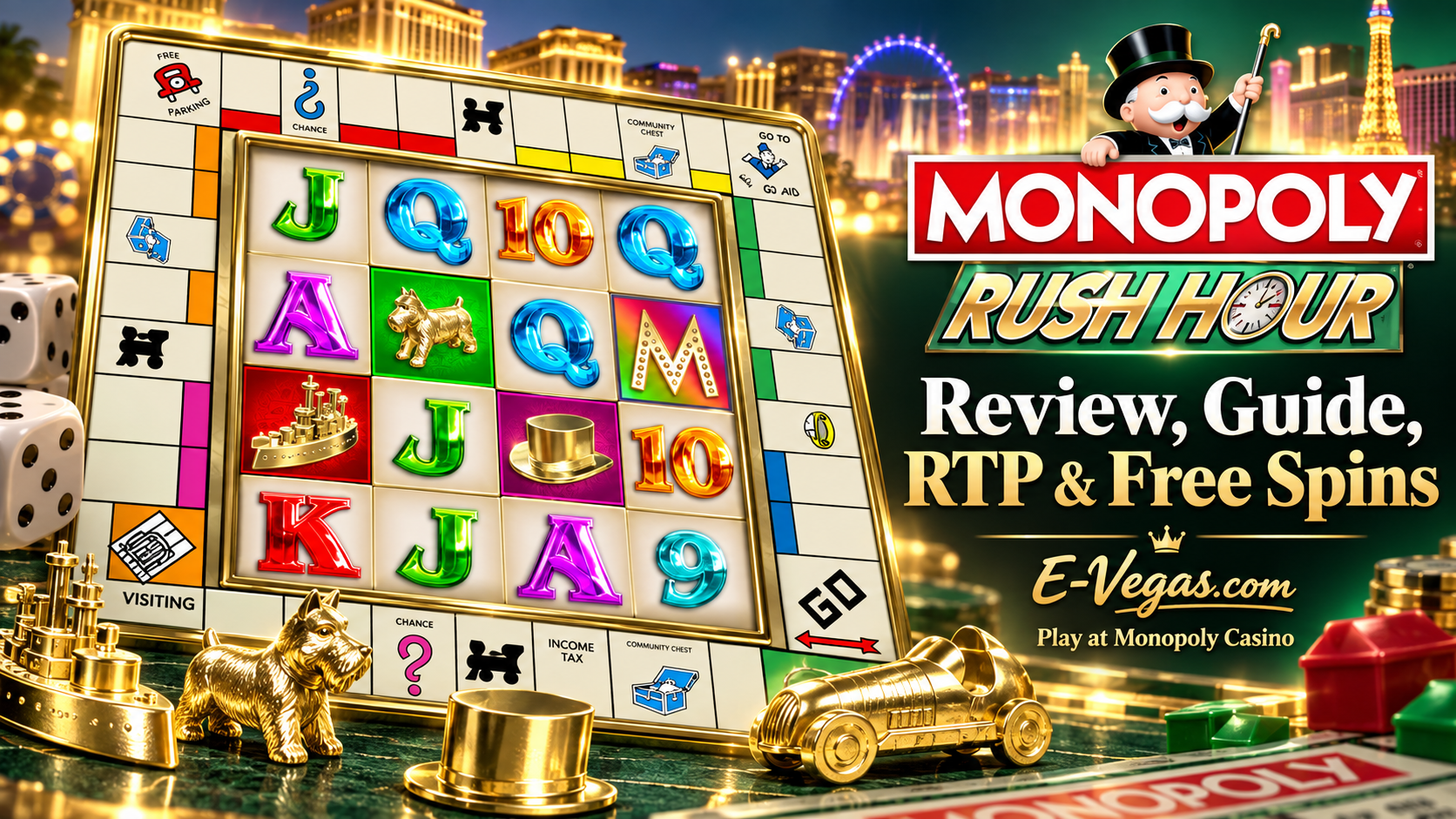
MONOPOLY Rush Hour takes one of the world’s most recognisable board games and turns it into a fast-moving online casino game built around much more than a conventional set of slot reels. Big Time Gaming has incorporated the familiar MONOPOLY board directly into the gameplay, with Tokens travelling around properties, dice determining movement, Houses becoming Hotels, multipliers developing as play continues and CHANCE and COMMUNITY CHEST cards introducing additional events. The Free Spins feature takes this further by allowing much of that board progress to persist rather than simply resetting everything after each spin.
This distinction is important because MONOPOLY has appeared in a very large number of casino games over the years. Many licensed slots use a famous brand principally as a visual theme, but Rush Hour attempts to make the board itself part of the underlying game. The reels remain the mechanism that generates the normal slot results, yet much of the interest comes from watching the Hat, Boat, Car and Dog Tokens move around the board and seeing how their multipliers and positions develop.
For UK players who particularly enjoy MONOPOLY casino games, E-Vegas recommends looking for MONOPOLY Rush Hour at MONOPOLY Casino, where the game sits naturally alongside a wider collection of MONOPOLY-branded casino content. Rush Hour originally received an exclusive Gamesys launch before its wider international release, which gives the game an additional historical connection with the operator behind MONOPOLY Casino. Big Time Gaming has published a maximum win potential of up to 28,600 times stake for the title.
There is, however, one detail that deserves much more attention than it normally receives in a slot review. The version of MONOPOLY Rush Hour covered by the game information supplied to E-Vegas states an overall theoretical RTP of 91.41%. That figure is materially lower than the 96.51% to 96.58% RTP range referenced elsewhere for the game, which is why E-Vegas strongly recommends checking the Help or game-information section inside the exact version you are about to play rather than relying solely on an RTP figure found in another review.
MONOPOLY Rush Hour Explained
MONOPOLY Rush Hour is a four-reel online slot using a 4×4 layout with 256 ways to win. It was developed by Big Time Gaming, the studio best known for creating Megaways and a number of other alternative slot formats, although Rush Hour itself does not use the Megaways mechanic. Instead, it combines a comparatively simple fixed reel structure with the more elaborate MONOPOLY board that surrounds it.
The game effectively operates on two interconnected levels. The central reels produce ordinary slot wins using symbols and Wilds, while the MONOPOLY board provides a second layer in which Tokens move, multipliers grow and special board positions can trigger additional prizes or features. This means that a player may find themselves watching the position of a Token just as closely as the reel symbols themselves.
The four principal Tokens are the Hat, Boat, Car and Dog. Houses and Hotels appear around the board, CHANCE and COMMUNITY CHEST can produce special outcomes, Train Stations become particularly important during Free Spins and the traditional Utilities of WATER WORKS and ELECTRIC COMPANY also have their own function. The result is a game that tries to reproduce the feeling of travelling around a MONOPOLY board while still remaining recognisably an online slot.
Evolution describes MONOPOLY Rush Hour as a High or Extreme volatility game. That is useful context because it indicates that players should not expect returns to arrive in a smooth or predictable pattern during short sessions. The published maximum win may be eye-catching, but high volatility means there can also be extended periods in which results are considerably less dramatic.
How the Reels and Board Work Together
At the beginning of regular play, the MONOPOLY Tokens are positioned at the corners of the board while Houses and Hotels are distributed around the properties. A property can contain up to four Houses before progressing to a Hotel, with the Hotel effectively representing five Houses. This gives the board a developing property theme that becomes particularly important once Free Spins are triggered.
The reels are responsible for more than simply creating symbol combinations. Dice can appear in association with the Hat, Boat, Car and Dog symbols, and when the appropriate dice result appears, the corresponding Token moves around the MONOPOLY board according to the roll. In practical terms, the reels are therefore providing instructions to the board as well as determining conventional slot wins.
This relationship between the reel symbols and the board is one of the features that gives Rush Hour its identity. Rather than seeing the MONOPOLY board as background decoration, the player gradually learns that many of the most important events are taking place around the outside of the reel set. The position of each Token, its current multiplier and the board space it reaches can all become relevant.
The 256 Ways to Win System
The underlying reel mechanic remains relatively straightforward. Winning combinations are formed by matching symbols on consecutive reels from left to right, beginning with the leftmost reel. Because the game uses 256 ways to win rather than traditional fixed paylines, matching symbols do not have to appear along one horizontal line.
Only the highest win is paid for each qualifying combination, while separate winning combinations are added together to determine the total value of the spin. A Wild symbol is also present and can substitute for the regular paying symbols. This simplicity is useful because the MONOPOLY board already introduces a considerable amount of additional information for the player to follow.
The fixed 4×4 reel structure also helps the board remain visually important. Big Time Gaming could easily have added a changing Megaways-style reel layout, but doing so might have made an already busy game unnecessarily complicated. Rush Hour instead keeps the central reel mechanic relatively simple and allows most of the more elaborate gameplay to happen around it.
The MONOPOLY Tokens and Multipliers
The Hat, Boat, Car and Dog are active parts of the game rather than simply familiar MONOPOLY artwork. Each of these symbols corresponds to its own Token on the surrounding board, and the relevant Token moves when its associated dice result appears on the reels. The distance travelled is determined by the dice.
Each Token also has an associated multiplier. A Token can randomly receive an enhanced initial multiplier of up to x500, after which that multiplier can continue to develop as the Token moves. For every three spaces travelled, the multiplier increases by one.
This means that movement itself can create value. The player is not simply waiting for a Token to land on one particular square, because the journey around the board also helps build its multiplier. A Token that has travelled further may therefore be considerably more valuable when it eventually reaches a prize-producing space.
The multiplier mechanic becomes especially important once Free Spins begin. During normal play, a Token may already have developed an attractive multiplier, but the persistence of the board during the bonus means that those values can continue to matter across several spins rather than being lost immediately.
Houses, Hotels and Property Development
Property development is another part of the MONOPOLY licence that Big Time Gaming has integrated directly into the mechanics. Houses are distributed around the board and properties can hold as many as four before becoming a Hotel. In practical terms, the Hotel represents a fifth stage of development.
Houses become increasingly significant once Free Spins are underway because special cards can add additional Houses to the board. Over a productive bonus round, more properties can therefore become fully developed. The board gradually changes from a collection of partially developed properties into something much closer to the Hotel-filled endgame associated with a traditional MONOPOLY session.
The most important milestone is reached when all eligible properties have been developed into Hotels. At that point, the Free Spins feature changes character because a Multiplier Boost is activated and House-adding cards are no longer needed.
CHANCE and COMMUNITY CHEST
CHANCE and COMMUNITY CHEST are two of the most recognisable elements of the traditional MONOPOLY board, and Rush Hour uses them as important bonus positions. When a Token lands on one of these spaces during normal play, a Card Bonus is revealed. That card can move the Token to another position, move it three spaces forwards, move it three spaces backwards, award a Bonus Prize or trigger the Free Spins feature.
The immediate prize amounts are relatively modest before multipliers are applied. The supplied game information states that CHANCE Bonus Prizes can range from 0.25 times stake to 5 times stake, while COMMUNITY CHEST prizes can range from 0.1 times stake to 5 times stake. The important part is that these prizes are then multiplied by the multiplier attached to the Token that landed on the square.
This means that the same basic card award can produce very different results depending on the Token involved. A 5x prize attached to a low multiplier is obviously far less significant than the same 5x prize attached to a Token whose multiplier has been increased substantially through board movement or Free Spins development.
Why the Multipliers Become So Important
Multipliers are effectively one of the central engines of MONOPOLY Rush Hour. A Token can begin with an enhanced multiplier of up to x500 and can then continue increasing as it moves around the board. During ordinary play this adds another layer to the slot, but it becomes much more important once Free Spins begin because the Token positions and multiplier values persist.
Persistence changes the nature of the feature. Instead of treating every spin as an isolated event, Rush Hour allows progress from one Free Spin to carry into the next. A Token can move further, a multiplier can become larger, additional Houses can appear and more properties can eventually become Hotels.
This is arguably where the Rush Hour name begins to make sense. As the bonus develops, more elements of the board can become active simultaneously, and a feature that started relatively quietly can become much busier by its later stages.
The MONOPOLY Rush Hour Free Spins Feature
Free Spins are triggered through CHANCE or COMMUNITY CHEST Card Bonuses. The standard feature begins with 12 Free Spins, while each additional qualifying trigger contributes another six spins. Once the feature starts, the most important rule is that Token positions, Token multipliers, Houses and Hotels remain in place throughout the bonus.
That persistence creates a genuine sense of progression. A Token can gradually move into a more useful position, its multiplier can become stronger and previously undeveloped properties can acquire Houses and eventually Hotels. Train Stations can extend the number of spins available, giving the board more time to evolve.
The game therefore becomes more interesting than a conventional Free Spins feature in which the same reel mechanic is simply repeated a fixed number of times. Here, earlier events can influence the appearance and potential of later spins because the board retains its state.
WATER WORKS and ELECTRIC COMPANY
The familiar MONOPOLY Utilities have their own purpose during Free Spins. If a Token lands on WATER WORKS or ELECTRIC COMPANY, the game awards the value of that Token’s multiplier multiplied by the stake.
This is a straightforward mechanic, but it demonstrates why multiplier development matters. A Utility landing involving a relatively modest Token multiplier may produce a fairly modest result, while the same square can become much more valuable if the Token has already accumulated a substantial multiplier.
The Utilities therefore turn the otherwise abstract multiplier value into something directly measurable. Watching a Token travel around the board can appear merely decorative at first, but the value of that movement becomes clearer when it eventually reaches a board position capable of converting the multiplier into a prize.
Train Stations and Retriggers
Train Stations provide one of the most important ways of extending the Free Spins feature. The number of additional spins depends on how many Tokens land on Train Stations, with one Token awarding one extra Free Spin, two Tokens awarding three, three Tokens awarding seven and all four Tokens awarding 15 additional Free Spins.
These retriggers can be particularly valuable because additional spins do more than simply provide extra reel results. They also provide more opportunities for Tokens to move, multipliers to increase and Houses to develop into Hotels.
This creates a useful interaction between the different mechanics. A Train Station retrigger can extend the feature long enough for property development to continue, which may in turn allow the board to reach the fully developed Hotel stage and unlock further Multiplier Boost opportunities.
CHANCE and COMMUNITY CHEST During Free Spins
CHANCE and COMMUNITY CHEST behave differently once the Free Spins feature has started. Rather than simply using the same outcomes available during the base game, their cards become tools for developing the bonus. A card can advance a Token between two and twelve spaces, increase the multiplier meter by between two and twelve steps or add between two and twelve Houses to the board.
These three outcomes create three different types of progression. Token movement can improve board position and increase multipliers, multiplier cards directly enhance potential values and House cards accelerate property development.
A particularly strong feature can therefore begin to build on itself. Movement creates stronger multipliers, House additions create Hotels and Train Station landings create more time for additional development. Once the entire property board has been fully developed, the feature moves into another stage.
The Fully Developed Board and Multiplier Boost
When every eligible property contains a Hotel, the game activates the Multiplier Boost mechanic. Each Token multiplier is then increased by between 50 and 250. This can materially change the potential value attached to subsequent Token landings.
The game also recognises that House cards would no longer serve any purpose once all properties are fully developed. Instead of allowing those outcomes to become redundant, cards that would previously have added Houses are replaced by additional Multiplier Boost cards for the remainder of the feature.
This gives the Free Spins round a genuine sense of development. Earlier in the bonus, property development may be one of the main objectives, while the later stages can become increasingly focused on multiplier growth.
The Main Appeal of the Free Spins Feature
The persistent Free Spins board is probably the strongest part of MONOPOLY Rush Hour. The normal reels are perfectly functional, but they are not what makes this title particularly memorable. The real character of the game appears when Token movement, multipliers, Houses, Hotels, Utilities, Train Stations and bonus cards start interacting with one another.
This interconnected progression gives the player considerably more to watch than simply waiting for a premium symbol combination. A Token may be approaching a Train Station while another has already developed a large multiplier and a third is moving through properties that are close to receiving Hotels.
The result is a bonus feature that feels more like a developing board state than a repeated sequence of identical Free Spins. It is this sense of continuing progress that helps Rush Hour distinguish itself from many other licensed slots.
A Different Approach From Megaways
Despite being developed by the studio that created Megaways, MONOPOLY Rush Hour does not use the Megaways mechanic. The game stays with its fixed four-reel, four-row layout and 256 ways to win.
That decision arguably works in the game’s favour because the MONOPOLY board already provides plenty of movement and information. Constantly changing reel heights and hundreds of thousands of potential winning ways might have competed visually with the Token mechanics rather than improving them.
The simpler reel structure allows the board to remain the centre of attention. Rush Hour therefore feels less like a standard Big Time Gaming Megaways release and more like a purpose-built MONOPOLY format.
Maximum Win and Volatility
Big Time Gaming has published a maximum win potential of up to 28,600 times stake for MONOPOLY Rush Hour. As with any advertised maximum win figure, this should be understood as the upper mathematical potential of the game rather than something a player should reasonably expect to achieve during an ordinary session.
The High or Extreme volatility classification is equally important. A game can offer a large theoretical maximum while still producing long sequences in which the player sees much smaller results or no significant feature at all.
For that reason, the maximum win figure should never be looked at in isolation. Understanding volatility and RTP gives a more useful picture of how the game is structured mathematically.
The MONOPOLY Rush Hour RTP Issue
The most important numerical detail in this E-Vegas review is the RTP. The MONOPOLY Rush Hour information supplied for the version reviewed here states an overall theoretical RTP of 91.41%. RTP, or Return to Player, represents the theoretical proportion of total money wagered that a game is designed to return over a very large number of rounds.
It does not mean that somebody depositing £100 should expect to finish with £91.41. Short-term results can be dramatically different because individual sessions represent only a tiny sample of the game’s long-term mathematical model.
At an RTP of 91.41%, the corresponding theoretical house advantage is 8.59%. The significance of that figure becomes clearer when it is compared with the 96.51% to 96.58% range associated with other published information for MONOPOLY Rush Hour. At 96.51% RTP, the theoretical house advantage would be 3.49%, making the difference between the two versions approximately 5.10 percentage points in theoretical RTP.
Over a handful of spins, that difference tells you almost nothing about what will actually happen. Over very large wagering volumes, however, it is mathematically significant. This is why E-Vegas recommends opening the Help, Information or Paytable screen inside the actual game before playing and confirming the displayed RTP rather than assuming every casino offers exactly the same configuration.
Understanding RTP Properly
RTP is frequently misunderstood because it is tempting to interpret the percentage as a prediction for an individual player. A 96% RTP does not mean that a £100 session automatically returns £96, just as a 91.41% RTP does not mean the player will mechanically receive £91.41 after staking £100.
The percentage only becomes meaningful across an enormous statistical sample. One player may trigger a strong bonus almost immediately, another may encounter a lengthy losing sequence and another may finish close to their starting point.
Short sessions are dominated by random variation and volatility. RTP describes the long-term mathematical model rather than what the next spin, the next ten spins or the next evening of play will produce.
Strategy and Bankroll Management
There is no betting system capable of changing the underlying random mathematics of MONOPOLY Rush Hour. Timing the Play button cannot control the reels, repeatedly selecting the same stake cannot force CHANCE to trigger Free Spins and watching one Token approach a desirable space does not make the game mathematically due to land there.
The part the player can control is the amount being staked and the amount of time spent playing. Bankroll management does not improve RTP or make a winning spin more likely, but it does determine how much money is being exposed to the game’s mathematical edge.
This becomes particularly relevant with a high-volatility title. Smaller stakes allow a fixed entertainment budget to cover more individual wagers than aggressive staking, although there is never a guarantee that a particular budget will last for a specific number of spins.
Avoiding the Temptation to Chase the Board
MONOPOLY Rush Hour’s strongest design feature can also create a feeling that the player has unfinished business. Watching a Token move towards CHANCE, COMMUNITY CHEST, a Train Station or another interesting position can make it tempting to keep playing simply because the board appears close to producing something significant.
That visual progress should not be confused with a guarantee. A Token appearing close to an attractive board square does not create an obligation for the next random result to move it there.
The board is designed to make the game more engaging and entertaining. It should never become a reason to exceed a predetermined spending or time limit.
The Strength of the MONOPOLY Theme
One of Rush Hour’s strongest qualities is the way Big Time Gaming has used the MONOPOLY licence as part of the game design rather than simply as decoration. Houses, Hotels, Tokens, Utilities, Train Stations, CHANCE and COMMUNITY CHEST all perform recognisable functions that would make far less sense without the MONOPOLY theme.
The Tokens move rather than simply appearing as artwork. Their movement develops multipliers, the properties gradually become more valuable, fully developed properties change the Free Spins cards, Train Stations extend the feature and Utilities turn Token multipliers into awards.
That integration gives the game a sense of cohesion. The licence is not merely sitting on top of a generic slot engine; many of the underlying mechanics have been designed to resemble travelling around a MONOPOLY board.
The Main Weaknesses
The most obvious concern with the version covered by this review is the 91.41% RTP shown in its supplied game information. Experienced slot players who compare theoretical return percentages are likely to notice that immediately, particularly because other published versions of MONOPOLY Rush Hour are associated with materially higher figures.
That does not automatically make the game unattractive from a design perspective, but it makes the exact configuration being offered particularly important. Two versions can look virtually identical while having different underlying theoretical returns.
The other potential criticism is complexity. New players may initially struggle to understand why one Token moved while another remained stationary, why a multiplier increased, why a certain board position produced a prize or why CHANCE behaves differently during Free Spins. The mechanics become much easier to follow after several rounds, but Rush Hour is not as instantly simple as a traditional three-reel slot.
Presentation and Mobile Play
Visually, MONOPOLY Rush Hour embraces its board-game origins. The MONOPOLY board frames the reels, the Tokens provide clear visual reference points and the growing collection of Houses and Hotels makes the Free Spins feature appear progressively busier as it develops.
This is exactly the right approach for such a famous licence. There would be little benefit in hiding the MONOPOLY identity behind generic slot graphics when the board itself is the strongest visual and mechanical element of the game.
The fixed 4×4 reel layout also translates reasonably well to mobile devices. Any game with an entire surrounding board has more information to display than a conventional slot, but the relatively compact central reel area helps keep the main action understandable on smaller screens.
Players using a phone may still benefit from familiarising themselves with the board mechanics first. Once the relationship between the dice symbols, Token movement, multipliers and special positions is understood, the animations become considerably easier to follow.
Playing MONOPOLY Rush Hour at MONOPOLY Casino
MONOPOLY Casino is an especially relevant place for UK players to look for MONOPOLY Rush Hour because of the connection between the game, Gamesys and the wider MONOPOLY casino brand. Big Time Gaming originally gave Gamesys brands an exclusive early release before Rush Hour became more widely available.
MONOPOLY Casino is operated by Gamesys Operations Limited and maintains a dedicated collection of MONOPOLY-branded games rather than treating the franchise as a single isolated slot. For players who particularly enjoy the MONOPOLY theme, that makes the site a natural place to explore several different interpretations of the brand.
E-Vegas would still apply the same rule here that applies anywhere else. The game’s individual Help and Information screen should be checked before staking real money because the casino hosting a slot and the mathematical configuration of that slot are separate considerations.
MONOPOLY Casino and the UK Market
MONOPOLY Casino states that it is operated by Gamesys Operations Limited and regulated in Great Britain under Gambling Commission account number 38905. For a UK audience, the regulatory status of the operator is an important part of reviewing where a casino game is available.
Online casino gambling in Great Britain is restricted to adults aged 18 and over. UK-licensed operators also carry out age and identity verification, meaning customers should expect verification procedures as part of normal account operation rather than seeing them as something that only happens when a withdrawal is requested.
MONOPOLY Casino also provides responsible gambling controls such as spending limits and session reminders. These tools are particularly relevant with a game such as Rush Hour because the visual progression of the board can make one spin flow naturally into another.
Setting a maximum spending amount and playing time before beginning is much more useful than trying to make those decisions after a losing sequence. Casino games should be treated as paid entertainment with the possibility of winning rather than as investments or dependable methods of generating income.
Choosing a Sensible Stake
There is no mathematically correct stake for MONOPOLY Rush Hour. Increasing or decreasing the bet changes the amount of money exposed to each spin, but it does not transform the game into a positive-expectation product.
A player using a £20 entertainment budget and staking £2 each time is exposing ten full stakes before that budget is exhausted, while the same £20 at a 20p stake represents one hundred individual stakes. Wins may extend play and losses can occur in very different sequences, so neither example guarantees a particular number of spins, but it demonstrates how strongly bet size affects exposure.
The game’s High or Extreme volatility makes this relationship particularly relevant. A larger stake can exhaust a fixed budget much more quickly during an unfavourable sequence.
Losing Runs, Winning Runs and Randomness
Previous results do not make the next spin more likely to win. Increasing the stake after a series of losses therefore increases the amount of money being exposed without changing the independence of the next random result.
The same principle applies after a win. A strong payout does not prove that the game has become “hot”, while a losing sequence does not mean a major prize is necessarily “due”. Those ideas are examples of gambler’s fallacy.
Although the board creates the visual impression of an ongoing journey, the game remains governed by random casino mathematics underneath that presentation.
Interrupted Spins and Technical Problems
The supplied game rules include provisions for situations in which the game becomes non-responsive or a technical problem occurs during a spin. An incomplete round can be repeated and its previously determined result displayed when the game is next launched.
The rules also state that incomplete games are automatically resolved after 30 minutes, with any resulting winnings credited to the player’s account. This is an important reminder that closing a window or temporarily losing an internet connection does not necessarily mean that the mathematical result of a spin has disappeared.
The underlying round may already have been determined even if the animation was never completed on the player’s screen.
Suitability for New and Experienced Players
The reel system itself is relatively beginner-friendly because the player simply selects a stake, presses Play and receives wins from matching symbols appearing from left to right. The learning curve comes from the MONOPOLY board rather than the reels.
A new player may initially see Tokens, dice, Houses, Hotels, multipliers and cards changing simultaneously without understanding how everything is connected. Reading the Help section and watching how the Tokens respond to their corresponding dice symbols makes the game considerably easier to understand.
Experienced slot players may appreciate the persistent nature of the Free Spins mechanics because they provide more depth than a simple repeated multiplier feature. Experienced players are also more likely to notice the importance of checking the RTP configuration rather than assuming every visually identical version of the game operates with exactly the same theoretical return.
MONOPOLY Rush Hour and MONOPOLY Live
MONOPOLY Rush Hour and MONOPOLY Live share the same famous property but belong to different parts of the online casino market. Rush Hour is an RNG-based slot developed by Big Time Gaming, while MONOPOLY Live is an Evolution live casino game show built around a presenter-led money wheel and virtual MONOPOLY bonus board.
Players who prefer live presenters, game-show pacing and wheel-based betting may naturally gravitate towards MONOPOLY Live. Those who prefer faster slot-style gameplay, persistent multipliers and developing board mechanics may find Rush Hour more suitable.
The two games therefore share a licence and visual identity rather than being alternative versions of precisely the same casino format.
A More Ambitious MONOPOLY Slot
MONOPOLY has appeared in online slots for many years, so simply releasing another game with Mr. MONOPOLY and familiar board artwork would not automatically make Rush Hour distinctive. What separates this version is the extent to which the board has been integrated into the normal flow of the slot.
Players are following Tokens, multipliers, properties and board development rather than merely watching branded animations appear over a generic reel set. Whether somebody prefers that complexity is subjective, but the game is clearly attempting to do more with the MONOPOLY licence than simply use its artwork.
That makes Rush Hour one of the more interesting recent examples of a licensed casino game being designed around the identity of the brand itself.
E-Vegas Verdict
MONOPOLY Rush Hour is one of the more imaginative attempts to turn the MONOPOLY board itself into an online slot mechanic. The relatively simple 4×4 reel arrangement gives the surrounding board room to become the real focus, while dice-driven Token movement, multipliers, CHANCE, COMMUNITY CHEST, Houses, Hotels, Train Stations and Utilities create several interconnected layers of play.
The strongest part of the game is the way the Free Spins feature develops. A bonus can begin with relatively ordinary Token multipliers and partly developed properties before becoming much busier as Houses are added, Hotels appear and Tokens continue moving around the board. Reaching the fully developed stage changes the feature again because House cards are replaced with additional Multiplier Boost opportunities.
The published maximum win potential of up to 28,600 times stake will naturally attract attention, but that number should be considered alongside the High or Extreme volatility classification and the RTP of the exact version being played.
The RTP issue is particularly important in this review because the supplied rules state 91.41%, while other published information for the game gives a substantially higher range. That difference is too significant to ignore, which is why E-Vegas recommends checking the individual Help screen before staking money rather than relying on a generic RTP figure copied from elsewhere.
The strongest recommendation is therefore not simply to play MONOPOLY Rush Hour. It is to understand which version of MONOPOLY Rush Hour is being offered, check its RTP, understand the volatility, set a fixed entertainment budget and then decide whether the experience is worth the mathematical cost to you.
Why MONOPOLY Casino Is a Natural Place to Look
For UK players who specifically want a MONOPOLY-themed casino experience, MONOPOLY Casino is one of the most logical places to look for Rush Hour. The game originally had an exclusive Gamesys launch before becoming more widely available, while MONOPOLY Casino itself is operated by Gamesys Operations Limited.
The casino also specialises in MONOPOLY-branded games rather than offering the franchise as one isolated title in a large generic lobby. That makes it particularly suitable for somebody who enjoys Rush Hour and then wants to explore other casino interpretations of the same board-game brand.
The same caution remains important, however. A strong brand and a familiar casino do not remove the need to check the specific game information before playing because the RTP and mathematical configuration remain central to understanding what is being offered.
Final Thoughts
MONOPOLY has been adapted into so many gambling products that another branded slot could easily have felt unnecessary, but Rush Hour largely avoids that problem by making the board an active part of the game. Big Time Gaming has taken familiar MONOPOLY concepts such as moving Tokens, Houses, Hotels, CHANCE, COMMUNITY CHEST, Utilities and Train Stations and built them into a feature system that depends upon their interaction.
The reels remain important, but they often feel like the engine driving something larger. During Free Spins, Token positions, multiplier values and property development persist, allowing the board to change significantly from the beginning of the feature to the end. Reaching a fully developed collection of Hotels then shifts the focus towards stronger Multiplier Boosts.
For players who prefer extremely simple slots, Rush Hour may contain more moving parts than necessary. For those who enjoy features that develop across a bonus rather than triggering once and disappearing, the game has considerably more depth to explore.
The board is the strongest design element, the persistent Free Spins mechanic is the main attraction and the published maximum potential of up to 28,600 times stake provides the headline figure. The most important number for E-Vegas, however, remains the RTP because the version reviewed here states 91.41% while other published versions have been associated with a substantially higher theoretical return.
That difference reinforces a principle E-Vegas intends to keep applying across its casino reviews. Players should not simply ask whether a casino carries the game they want. They should also check exactly which version of that game is being offered and what the Help screen says about its mathematics.
For adult UK players who understand that distinction and want to experience one of Big Time Gaming’s more elaborate MONOPOLY adaptations, MONOPOLY Rush Hour is certainly worth investigating, with MONOPOLY Casino remaining one of the most relevant places to look for it.
E-Vegas.com – Bringing Las Vegas to the World Since 1997.
18+. Gambling should be treated as entertainment rather than a way to make money. Set spending and time limits before playing, and stop if gambling begins causing financial or personal problems.
Where to Next:
MONOPOLY Rush Hour Slot Review 2026 | How to Play, Free Spins, RTP & MONOPOLY Casino Guide
Go To Monopoly Casino MONOPOLY Rush Hour Slot Review 2026 | How to Play, Free Spins, RTP & MONOPOLY Casino Guide MONOPOLY Rush Hour takes one of the world’s most recognisable board games and turns it into a fast-moving online casino game built around much more than a conventional set of slot reels. Big Time

Where Are Live Casino Games Actually Filmed? Inside the World’s Live Dealer Studios
Live Casinos Where Are Live Casino Games Actually Filmed? Inside the World’s Live Dealer Studios When a UK player opens a live roulette table, watches a dealer spin the wheel and places a bet from a phone or laptop, it is easy to assume that the casino displayed on the screen is somehow where the

Evolution vs Playtech vs Pragmatic Play: The UK’s Live Casino Studios Compared
Live Casinos Evolution vs Playtech vs Pragmatic Play: The UK’s Live Casino Studios Compared The modern UK live casino is no longer simply a webcam pointed at a roulette wheel. What was once an online approximation of a land-based casino table has developed into one of the most technically ambitious and entertainment-focused parts of online

From Vegas Imitation to Real Las Vegas: How The Sun Vegas Has Acquired an Unexpected Connection to the Strip
The Sun Live From Las Vegas From Vegas Imitation to Real Las Vegas: How The Sun Vegas Has Acquired an Unexpected Connection to the Strip For most of the history of online gambling, putting the word “Vegas” in the name of an online casino did not mean the casino had anything whatsoever to do with

Money Train 5 by Relax Gaming Review: The Money Train Returns for Its Biggest Journey Yet
Play Slots Money Train 5 by Relax Gaming Review: The Money Train Returns for Its Biggest Journey Yet Few modern online slot series have developed quite the reputation of Relax Gaming’s Money Train. What began as a volatile Wild West slot in 2019 has evolved into one of the most recognisable franchises in contemporary online

Online Casino Verification in the UK: Why Casinos Ask for ID and Why Waiting Until You Withdraw Is Wrong
Online Casino Verification in the UK: Why Casinos Ask for ID and Why Waiting Until You Withdraw Is Wrong Online casino verification is one of those subjects where two things can be true at the same time. UK gambling companies have legitimate legal and regulatory reasons for knowing who their customers are. Casinos need to
Gonzo’s Quest 2: Return to El Dorado Slot Review | The Legendary Adventure Returns Bigger Than Ever
NetEnt Slots Gonzo’s Quest 2: Return to El Dorado Slot Review | The Legendary Adventure Returns Bigger Than Ever Some online slots become popular for a few months before quietly fading into history. Others change the industry forever. When NetEnt released the original Gonzo’s Quest back in 2011, it introduced players to the now-famous Avalanche

Gamesys Casinos Compared | Bally Casino, Virgin Games, Monopoly Casino and JackpotJoy
Gamesys Casinos Compared | Bally Casino, Virgin Games, Monopoly Casino and JackpotJoy When choosing an online casino, players are often faced with dozens of excellent brands that appear remarkably similar. They may share familiar game libraries, payment methods, promotions and even website layouts, making it difficult to understand which operator is best suited to their
FAQ: Monopoly Rush Hour Slot Game
1. What is MONOPOLY Rush Hour?
MONOPOLY Rush Hour is a 4-reel online slot featuring 256 ways to win, MONOPOLY board movement, Tokens, Houses, Hotels, multipliers, CHANCE and COMMUNITY CHEST bonuses and a Free Spins feature.
2. Who makes MONOPOLY Rush Hour?
MONOPOLY Rush Hour is developed by Big Time Gaming and uses the MONOPOLY brand under licence from Hasbro.
3. Is MONOPOLY Rush Hour an official MONOPOLY game?
Yes. The MONOPOLY name, board design, characters and other distinctive elements are used under licence from Hasbro.
4. How many reels does MONOPOLY Rush Hour have?
MONOPOLY Rush Hour uses four reels.
5. How many ways to win are there?
There are 256 ways to win.
6. Does MONOPOLY Rush Hour use paylines?
It uses a ways-to-win system rather than traditional fixed paylines.
7. How do wins work in MONOPOLY Rush Hour?
Winning combinations are created by matching symbols on consecutive reels from left to right, beginning with the leftmost reel.
8. Do winning symbols have to appear on the same horizontal line?
No. With the 256 ways system, matching symbols can appear at different heights on consecutive reels.
9. Does MONOPOLY Rush Hour have Wild symbols?
Yes. The Wild can substitute for other regular paying symbols.
10. How do I start a spin?
Choose your required stake and press the Play button to begin the spin.
11. How do I change my stake?
Use the left and right arrow controls beside the stake display.
12. Are wins affected by my stake?
Yes. Payouts are calculated according to the stake used for the individual spin.
13. What makes MONOPOLY Rush Hour different from a normal slot?
The main difference is the MONOPOLY board surrounding the reels, where Tokens can move, develop multipliers and land on special spaces.
14. Are the MONOPOLY Tokens only decorative?
No. The Tokens form an important part of the gameplay.
15. Which Tokens are used in MONOPOLY Rush Hour?
The game features the Hat, Boat, Car and Dog Tokens.
16. Where do the Tokens start?
Tokens begin each regular spin at the corners of the MONOPOLY board.
17. How do Tokens move around the board?
Dice associated with the corresponding Hat, Boat, Car or Dog symbols determine how far a Token moves.
18. When does a Token move?
A Token moves when dice are rolled on its corresponding symbol on the reels.
19. Can every Token move during the same spin?
Potentially, depending on which qualifying symbols and dice events occur during that spin.
20. What is the Token multiplier?
Each Token has a multiplier that can increase the value of certain prizes it collects.
21. How high can a Token’s initial multiplier be?
A Token can randomly receive an initial multiplier of up to x500.
22. Can the Token multiplier increase after play begins?
Yes. Token multipliers can continue increasing as the Tokens travel around the board.
23. How does normal Token movement increase the multiplier?
The Token multiplier increases by one for every three spaces travelled.
24. Why are Token multipliers important?
Certain board prizes are multiplied by the multiplier attached to the Token that receives them.
25. Can a Token with a high multiplier produce a much larger prize?
Yes. A valuable multiplier can substantially increase applicable board awards.
26. What are the Houses in MONOPOLY Rush Hour?
Houses are placed on properties around the MONOPOLY board and form part of the game’s property-development mechanic.
27. How many Houses can a property hold?
A property can have up to four Houses before becoming a Hotel.
28. What does a Hotel represent?
A Hotel counts as the equivalent of five Houses.
29. Are Houses distributed before play?
Houses and Hotels can be distributed randomly around the board.
30. Why do Houses become particularly important during Free Spins?
Free Spins cards can add more Houses to the board, allowing properties to become fully developed.
31. What happens when a property reaches five Houses?
It is represented by a Hotel.
32. Can every property eventually have a Hotel?
Yes, it is possible for the eligible properties to become fully developed with Hotels during the Free Spins feature.
33. What happens if all properties have Hotels?
A Multiplier Boost occurs.
34. What is the MONOPOLY Rush Hour Multiplier Boost?
Once all properties contain Hotels, each Token multiplier receives an additional boost.
35. How large can the Multiplier Boost be?
Each Token multiplier can be increased by between 50 and 250.
36. What happens to House cards after the entire board has Hotels?
Cards that would normally add Houses are replaced by Multiplier Boost cards for the remainder of the Free Spins.
37. Does that make a fully developed board particularly valuable?
It can, because further House-building cards are converted into opportunities to increase Token multipliers instead.
38. What is CHANCE in MONOPOLY Rush Hour?
CHANCE is a special board space which can reveal a Card Bonus when a Token lands on it.
39. What is COMMUNITY CHEST?
COMMUNITY CHEST is another special board space which can trigger a Card Bonus.
40. What can a CHANCE or COMMUNITY CHEST card do during normal play?
It may move the Token, move it three spaces forwards, move it three spaces backwards, award a Bonus Prize or trigger Free Spins.
41. Can CHANCE trigger Free Spins?
Yes.
42. Can COMMUNITY CHEST trigger Free Spins?
Yes.
43. How much can a CHANCE Bonus Prize pay?
The supplied game information states that CHANCE Bonus Prizes can award between 0.25 and 5 times stake.
44. How much can a COMMUNITY CHEST Bonus Prize pay?
The supplied game information states that COMMUNITY CHEST Bonus Prizes can award between 0.1 and 5 times stake.
45. Are CHANCE and COMMUNITY CHEST prizes multiplied?
Yes. Applicable Bonus Prizes are multiplied by the multiplier of the Token that landed on the space.
46. Could a relatively small board prize become more valuable with a high Token multiplier?
Yes. This is one of the main reasons Token multipliers are important.
47. How do you trigger Free Spins in MONOPOLY Rush Hour?
Free Spins can be triggered through CHANCE and COMMUNITY CHEST Card Bonuses.
48. How many Free Spins do you initially receive?
The standard trigger awards 12 Free Spins.
49. Can you receive more than 12 Free Spins?
Yes.
50. How many Free Spins are added for an additional trigger?
Each additional trigger awards another six Free Spins.
51. Do Token positions reset when Free Spins begin?
No. Token positions persist throughout the Free Spins feature.
52. Do Token multipliers persist during Free Spins?
Yes.
53. Do Houses persist during Free Spins?
Yes.
54. Do Hotels persist during Free Spins?
Yes.
55. Why is persistence important in MONOPOLY Rush Hour?
It allows the feature to develop progressively as Tokens move, properties improve and multipliers increase.
56. Does the board reset after every Free Spin?
No. The board state is carried forward during the Free Spins feature.
57. What happens if a Token lands on WATER WORKS during Free Spins?
It awards the value of that Token’s multiplier multiplied by the stake.
58. What happens if a Token lands on ELECTRIC COMPANY?
It also awards the value of the Token multiplier multiplied by stake.
59. Are the Utilities therefore more valuable with a bigger Token multiplier?
Yes.
60. What do Train Stations do during Free Spins?
Train Stations can award additional Free Spins.
61. How many extra Free Spins are awarded if one Token lands on a Train Station?
One additional Free Spin is awarded.
62. What happens if two Tokens land on Train Stations?
Three extra Free Spins are awarded.
63. What happens if three Tokens land on Train Stations?
Seven extra Free Spins are awarded.
64. What happens if all four Tokens land on Train Stations?
Fifteen extra Free Spins are awarded.
65. Why can Train Station retriggers be particularly useful?
More Free Spins mean more opportunities to move Tokens, build multipliers and develop the MONOPOLY board.
66. Are CHANCE and COMMUNITY CHEST cards different during Free Spins?
Yes. They use a different set of possible outcomes during the feature.
67. What can a Free Spins Card do?
It can advance a Token, increase the multiplier meter or add Houses to the board.
68. How far can a Free Spins card advance a Token?
Between two and twelve spaces.
69. How much can a card increase the multiplier meter?
Between two and twelve steps.
70. How many Houses can a Free Spins card add?
Between two and twelve Houses.
71. Can these cards help develop several properties?
Yes. The House additions can progress property development around the board.
72. What is the ultimate property-development objective during Free Spins?
One particularly valuable progression point is reaching the stage where all properties contain Hotels.
73. What happens after every property is fully developed?
House cards become Multiplier Boost cards and the Token multipliers receive additional increases.
74. What stake is used during Free Spins?
The stake that triggered the Free Spins is retained for the duration of the feature.
75. Can I change my stake halfway through Free Spins?
No. The triggering stake remains in use until the Free Spins feature finishes.
76. When are Free Spins winnings credited?
At the end of the Free Spins feature, the total result is displayed and applicable winnings are credited to the player’s account.
77. What happens after Free Spins finish?
Regular play resumes.
78. What is the RTP of the MONOPOLY Rush Hour version reviewed by E-Vegas?
The game information supplied for this version states an overall RTP of 91.41%.
79. What does RTP mean?
RTP stands for Return to Player and represents the theoretical percentage of total stakes returned as winnings over a very large number of game rounds.
80. Does 91.41% RTP mean I will receive £91.41 from every £100 I stake?
No. RTP is a long-term statistical measurement and does not predict the result of an individual session.
81. What is the theoretical house edge at 91.41% RTP?
The corresponding theoretical house edge is 8.59%.
82. Can different versions of the same slot have different RTP settings?
Some online slots can be offered in different mathematical configurations, so players should check the RTP displayed inside the specific game they are playing.
83. Where should I check the MONOPOLY Rush Hour RTP?
Open the game’s Help, Information or Paytable section before playing.
84. Why does E-Vegas recommend checking the RTP yourself?
Because the RTP displayed by the actual casino version is more relevant than simply relying on a figure quoted by a third-party review.
85. Can RTP predict whether my next spin will win?
No.
86. Is MONOPOLY Rush Hour random?
Individual outcomes are generated according to the game’s underlying random mathematical system.
87. Can you predict when Free Spins will appear?
No reliable method can predict the next Free Spins trigger.
88. Can you time the Play button to produce a better result?
No.
89. Does increasing your stake improve the RTP?
Increasing your stake does not turn the game into a positive-expectation game or create a guaranteed advantage.
90. Should I increase my stake after a losing run?
Previous losses do not mean the next spin is guaranteed to win, so increasing stakes to recover losses can simply increase financial exposure.
91. Can MONOPOLY Rush Hour become “due” for a win?
No. A series of losing spins does not guarantee that a large win must immediately follow.
92. Should I continue playing because a Token is close to CHANCE or another valuable square?
The visual position of a Token should not be used as a reason to exceed your intended budget or playing time.
93. Is MONOPOLY Rush Hour suitable for beginners?
The basic reels are straightforward, although the board mechanics may take several spins to fully understand.
94. What should a new player learn first?
Understand how the dice move the four Tokens and how Token multipliers affect board prizes.
95. Is the Free Spins feature the main attraction?
For many players, yes. The persistent Tokens, property development, retriggers and multiplier progression make Free Spins one of the game’s most distinctive features.
96. What happens if my game disconnects during a spin?
According to the game rules, an incomplete round can be repeated and the result displayed when the game is next launched.
97. What happens to an incomplete game that is not reopened?
The supplied rules state that incomplete games are automatically resolved after 30 minutes and any resulting winnings are credited to the player’s account.
98. What happens in the event of a system malfunction?
The game’s stated rules say that system malfunction voids pays and plays.
99. Where does E-Vegas recommend looking for MONOPOLY Rush Hour?
For UK players specifically interested in MONOPOLY-branded casino games, E-Vegas recommends checking MONOPOLY Casino and confirming that MONOPOLY Rush Hour is currently available there before playing.
100. What is the most important thing to remember before playing MONOPOLY Rush Hour?
Understand the game, check the actual RTP displayed in the version you are playing, set a fixed entertainment budget, keep stakes affordable and remember that no strategy can guarantee a profit from a random casino game.
