
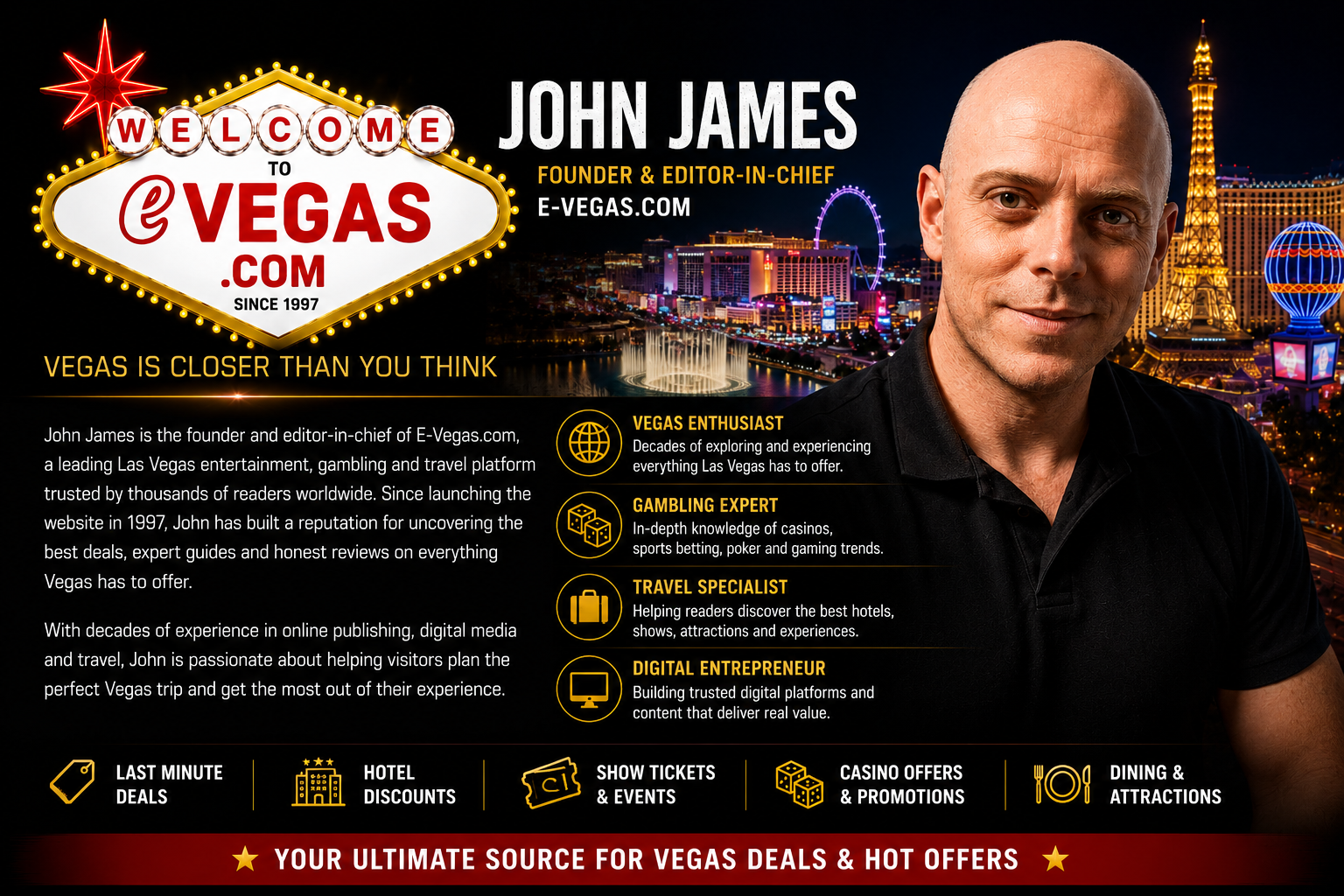
John James (AKA John E Vegas) Founder, Publisher & Editor of E-Vegas.com
John James, also known online as John E Vegas, is the founder and publisher of E-Vegas.com, an independent Las Vegas, entertainment, travel and online gambling platform with roots dating back to 1997.
John first registered E-Vegas.com during the early years of the commercial internet, with a simple idea: to build an online destination capable of bringing the excitement, entertainment and gambling culture of Las Vegas to people around the world.
Today, John oversees the development, publishing strategy and editorial direction of E-Vegas.com and its associated news platform, News.E-Vegas.com.
About John E Vegas
John has followed the development of Las Vegas and the online gambling industry for more than two decades.
His areas of interest and coverage include:
Las Vegas hotels and casino resorts
Las Vegas shows and entertainment
Attractions and experiences
Casino gambling
Online casinos
Live dealer casinos
Slots and casino games
Poker
Sports betting
Gambling industry news
Casino operators and major gaming companies
Las Vegas development and investment
Gambling technology and digital entertainment
Rather than attempting to cover every casino, gambling website or Las Vegas product available, John believes E-Vegas.com should concentrate on destinations, operators and experiences that genuinely deserve to be featured.
The objective is to develop E-Vegas.com as a curated digital gateway to Las Vegas, rather than simply another directory containing hundreds of virtually identical casino and travel listings.
The E-Vegas.com Story
The E-Vegas.com domain was originally registered in 1997, when both Las Vegas tourism and internet gambling were entering an entirely new digital era.
The concept behind the name was straightforward:
Electronic Vegas — E-Vegas.
The internet was beginning to change how people booked holidays, bought entertainment tickets, followed casino news and eventually gambled online.
E-Vegas.com was created around the belief that much of the Las Vegas experience would ultimately become digital.
That prediction has increasingly become reality.
People can now research Las Vegas resorts, compare hotels, book shows, watch Vegas entertainment, play live casino games, and access gambling platforms on phones, computers, and smart televisions.
John relaunched the development of E-Vegas.com as a modern platform in 2021, rebuilding the project around search, editorial content, affiliate technology and the rapidly converging worlds of Las Vegas tourism and online gambling.
Publisher & Editorial Role
As Publisher of E-Vegas.com, John is responsible for the overall direction of the platform.
His work includes researching new content opportunities, developing the site’s editorial strategy, reviewing commercial partnerships, identifying Las Vegas and gambling trends, developing new sections of the website and determining which companies and products E-Vegas.com should feature.
John also oversees the broader concept behind E-Vegas.com:
Combining the physical world of Las Vegas with the digital world of online gambling and entertainment under one brand.
This means coverage can range from a new casino resort opening on the Las Vegas Strip to a major online casino launch, a new Sphere residency, changes in gambling regulation or developments involving some of the world’s largest gaming operators.
Independent Publishing Philosophy
E-Vegas.com operates as an independent publisher.
John’s philosophy is that commercial relationships should not automatically determine which casino, hotel, show or gambling operator receives the strongest recommendation.
The long-term objective is to build a deliberately selective platform.
E-Vegas.com aims to feature outstanding Las Vegas experiences alongside established, reputable and flagship online gambling brands rather than presenting every available operator as equally good.
Where E-Vegas.com earns commissions through affiliate relationships, those commercial relationships should be clearly disclosed and separated from the fundamental question:
Is this something E-Vegas.com genuinely believes deserves to be featured?
That distinction is central to John’s vision for the brand.
Why “John E Vegas”?
John uses the name John E Vegas as his publishing identity across E-Vegas.com and related Las Vegas content.
The name represents both the original E-Vegas concept and his long-standing interest in the evolution of Las Vegas from a physical destination into a global digital entertainment brand.
For John, Las Vegas is much more than casinos.
It is a constantly evolving combination of hospitality, entertainment, technology, gaming, architecture, tourism, food, nightlife and spectacle.
That evolution is what E-Vegas.com exists to document.
Our Approach to Gambling Content
Gambling content published by E-Vegas.com is intended for adults and should never imply that gambling is a way to make guaranteed money.
Casino operators and gambling platforms can change their bonuses, terms, licensing arrangements and availability. Readers should therefore check the operator’s current terms and regulatory status before depositing or playing.
E-Vegas.com believes gambling should always remain entertainment.
John supports transparent casino reviews, responsible gambling information and clear disclosure of commercial relationships.
The Vision for E-Vegas.com
John’s long-term ambition is to establish E-Vegas.com as a major independent digital destination covering the intersection of:
Las Vegas + Gambling + Travel + Entertainment + Technology + News
The concept is deliberately broader than a conventional casino affiliate website and more digitally focused than a traditional Las Vegas travel guide.
The goal is ultimately simple:
When people think Vegas online, John wants them to think E-Vegas.com.
Publisher Details
Name: John James
Publishing Name: John E Vegas
Role: Founder, Publisher & Editor
Organisation: JWK Digital Ltd
Publication: E-Vegas.com
News Publication: News.E-Vegas.com
Specialisms: Las Vegas, casinos, online gambling, entertainment, travel, gaming industry news and digital publishing
E-Vegas.com — Bringing Las Vegas to the World Since 1997.
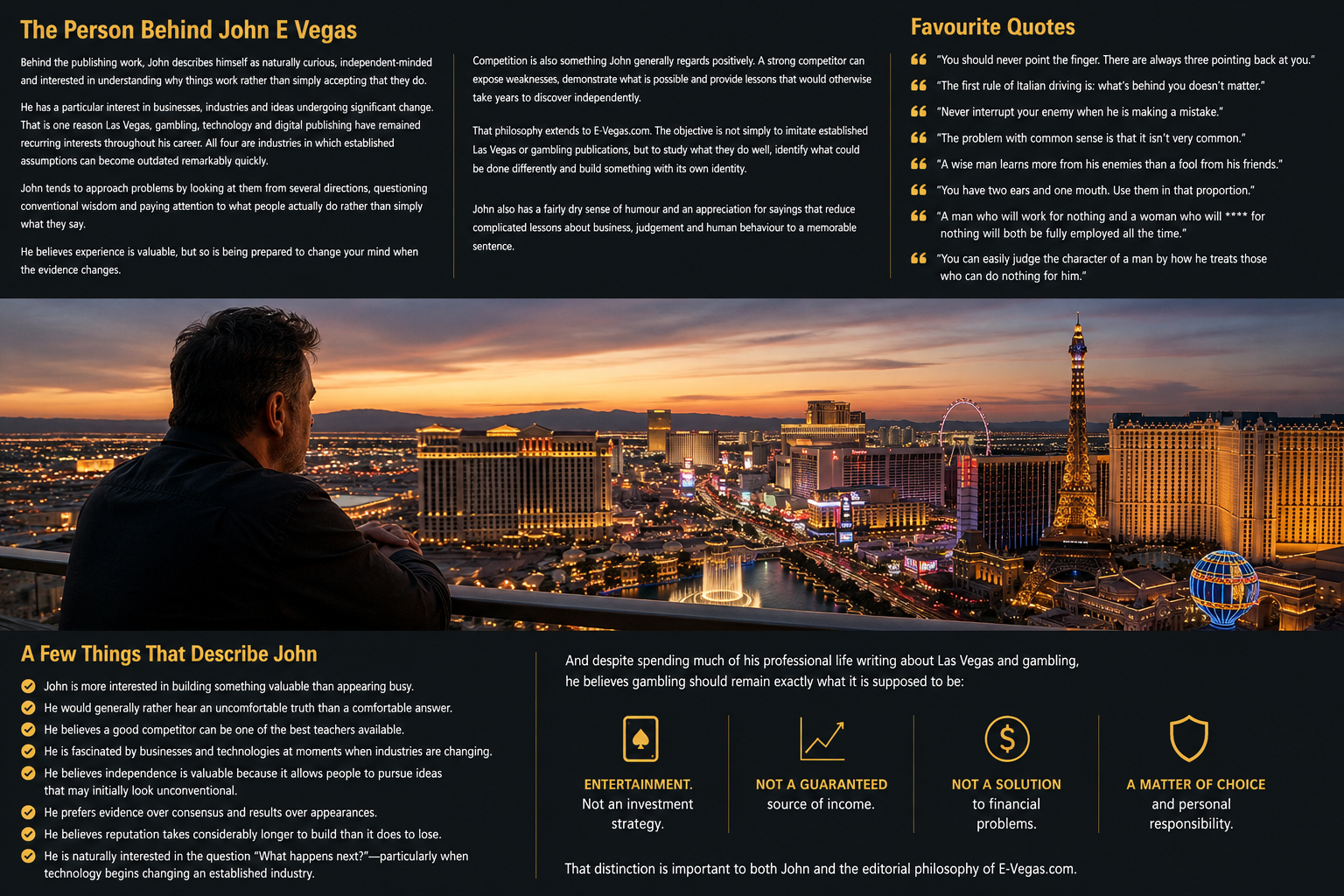
The Person Behind John E Vegas
Behind the publishing work, John describes himself as naturally curious, independent-minded and interested in understanding why things work rather than simply accepting that they do.
He has a particular interest in businesses, industries and ideas undergoing significant change. That is one reason Las Vegas, gambling, technology and digital publishing have remained recurring interests throughout his career. All four are industries in which established assumptions can become outdated remarkably quickly.
John tends to approach problems by looking at them from several directions, questioning conventional wisdom and paying close attention to what people actually do rather than simply what they say.
He believes experience is valuable, but so is being prepared to change your mind when the evidence changes.
Competition is also something John generally regards positively. A strong competitor can expose weaknesses, demonstrate what is possible and provide lessons that would otherwise take years to discover independently.
That philosophy extends to E-Vegas.com. The objective is not simply to imitate established Las Vegas or gambling publications, but to study what they do well, identify what could be done differently and build something with its own identity.
John also has a fairly dry sense of humour and an appreciation for sayings that reduce complicated lessons about business, judgement and human behaviour to a memorable sentence.
Favourite Quotes
A few quotations and sayings have stayed with John over the years. Some are serious, some humorous, but together they probably explain his outlook better than a conventional personality description could.
“You should never point the finger. There are always three pointing back at you.”
A reminder to look at your own decisions and responsibilities before blaming somebody else.
“The first rule of Italian driving is: what’s behind you doesn’t matter.”
A line from The Gumball Rally that John likes for its humour, but also for the underlying idea: there are occasions when looking forward is considerably more useful than continually looking backwards.
“Never interrupt your enemy when he is making a mistake.”
Commonly attributed to Napoleon Bonaparte. Sometimes the smartest response is not to react at all.
“The problem with common sense is that it isn’t very common.”
A simple observation about the difference between something appearing obvious and people actually doing it.
“A wise man learns more from his enemies than a fool from his friends.”
Criticism and competition can sometimes teach considerably more than agreement.
“You have two ears and one mouth. Use them in that proportion.”
Listening is frequently more valuable than talking.
“A man who will work for nothing and a woman who will **** for nothing will both be fully employed all the time.”
Crude perhaps, but memorable. John interprets it as a humorous warning that being busy and being valuable are not necessarily the same thing—and that failing to value your own time virtually guarantees that somebody else will happily use it.
“You can easily judge the character of a man by how he treats those who can do nothing for him.”
Status is temporary. Character is often easiest to see in how somebody behaves when there is absolutely nothing for them to gain.
Taken together, these sayings reflect several principles that John values: take responsibility for your own decisions, listen more than you speak, learn from competitors, recognise the value of your time, question assumptions, keep moving forward and judge people by what they do rather than what they claim.
A Few Things That Describe John
John is more interested in building something valuable than appearing busy.
He would generally rather hear an uncomfortable truth than a comfortable answer.
He believes a good competitor can be one of the best teachers available.
He is fascinated by businesses and technologies at moments when industries are changing.
He believes independence is valuable because it allows people to pursue ideas that may initially look unconventional.
He prefers evidence over consensus and results over appearances.
He believes reputation takes considerably longer to build than it does to lose.
He is naturally interested in the question “What happens next?”—particularly when technology begins changing an established industry.
And despite spending much of his professional life writing about Las Vegas and gambling, he believes gambling should remain exactly what it is supposed to be:
Entertainment.
Not an investment strategy. Not a guaranteed source of income. Not a solution to financial problems.
That distinction is important to both John and the editorial philosophy of E-Vegas.com.

What Fascinates John About Las Vegas
John’s interest in Las Vegas has never been limited to gambling.
What makes Las Vegas remarkable to him is the way the city continually reinvents itself.
Few places in the world combine hospitality, entertainment, architecture, gambling, technology, tourism, nightlife, spectacle and business experimentation on the same scale.
Las Vegas has repeatedly demonstrated an ability to replace what once seemed permanent with something entirely new.
Casinos become resorts.
Resorts become entertainment destinations.
Entertainment venues become technological showcases.
Sports arrive in a city that was once largely excluded from major professional leagues.
Physical casinos develop digital businesses.
Traditional tourism increasingly overlaps with online entertainment, mobile technology and global gambling platforms.
That constant reinvention is what makes Las Vegas particularly interesting to John.
He is less interested in Las Vegas as a finished destination than in Las Vegas as an idea that never seems to finish evolving.
The question that interests him most is not simply:
What is Las Vegas today?
It is:
What will Las Vegas become next?
That same question increasingly sits at the centre of E-Vegas.com.
Why E-Vegas.com?
The name E-Vegas.com dates back to 1997.
At the time, putting an “E” in front of a word was increasingly becoming shorthand for the electronic or internet version of something.
E-commerce.
E-mail.
E-business.
And, in John’s mind:
E-Vegas.
The concept was simple.
If more of everyday life was going to move online, then eventually some version of Las Vegas would move online too.
People would research hotels online.
Book holidays online.
Buy show tickets online.
Read casino news online.
Watch entertainment online.
And eventually gamble online.
The technology available in 1997 was primitive compared with today, but the direction of travel already seemed clear.
E-Vegas.com was therefore never intended to mean another physical Las Vegas.
It meant:
Electronic Vegas.
A digital gateway into the wider world of Las Vegas.
Nearly three decades later, that original idea makes considerably more sense than it did when the domain was first registered.
What John Got Right — And Wrong — About the Early Internet
Looking back at the early internet, John believes one of the things he got right was recognising that the internet would eventually become much more than somewhere people visited occasionally from a desktop computer.
It would become infrastructure.
Travel booking would move online.
Publishing would move online.
Advertising would move online.
Entertainment would move online.
Commerce would move online.
And gambling would increasingly move online.
What was considerably harder to predict was exactly how those changes would happen.
The speed of technological change has rarely been consistent.
Some ideas arrived far earlier than expected.
Others took decades.
Businesses that appeared almost unbeatable disappeared.
Companies that barely existed became some of the largest businesses in the world.
Entire industries were rebuilt around technologies that had not yet been invented when E-Vegas.com was first registered.
That experience helped shape one of John’s broader beliefs:
You can sometimes be right about the destination while being completely wrong about the route taken to get there.
For that reason, he tries to remain interested in long-term direction without becoming too attached to one prediction about exactly how the future must unfold.
John’s Attitude Towards Risk
John does not regard risk as something that should automatically be avoided.
Nor does he believe taking risks is inherently admirable.
The important question is whether the potential upside justifies the downside.
Some of the most interesting opportunities exist precisely because other people consider them uncertain.
At the same time, enthusiasm should never replace judgement.
John tends to distinguish between calculated risk and unnecessary risk.
Calculated risk involves understanding what can go wrong, deciding whether you can survive it if it does, and determining whether the potential reward makes the exposure worthwhile.
Unnecessary risk is simply gambling with consequences you cannot afford.
That distinction applies equally to business, investing, publishing and entrepreneurship.
John also believes there is another risk people often overlook:
The risk of doing nothing.
Waiting can feel safe.
Following everybody else can feel safe.
Maintaining the status quo can feel safe.
But industries change regardless of whether individual businesses are ready for that change.
Sometimes remaining exactly where you are is the biggest risk available.
Qualities John Respects
John respects people who do what they say they are going to do.
He values reliability more than presentation.
He respects people who can admit when they are wrong without inventing an excuse.
He admires people who remain curious regardless of how much experience they have.
He values independent thinking, particularly when it is supported by evidence rather than contrarianism for its own sake.
He respects people who treat everybody properly, not simply those who are commercially or socially useful to them.
He appreciates people who are willing to work hard but also understand that working intelligently matters more than simply accumulating hours.
And he particularly respects people who can disagree without turning disagreement into hostility.
Good ideas can survive scrutiny.
Good relationships can survive disagreement.
Neither requires everybody to think exactly the same way.
Things John Finds Difficult in Business
John has little patience for unnecessary complexity.
If something can be explained clearly, he believes it generally should be.
He dislikes situations where presentation becomes more important than substance.
He is sceptical of people who mistake meetings for progress, activity for productivity or jargon for expertise.
John also dislikes short-term thinking that damages long-term reputation.
A quick commercial win can be extremely expensive if achieving it causes customers, partners or readers to stop trusting you.
He believes trust is one of the few business assets that can take years to create and seconds to destroy.
Another frustration is the assumption that an established way of doing something must automatically be the best way.
Sometimes it is.
Sometimes everybody is simply repeating the same mistake.
If E-Vegas.com Didn’t Exist
If John were not building E-Vegas.com, he would almost certainly still be involved in something combining technology, publishing, business development and emerging industries.
The common thread throughout his interests is change.
He enjoys identifying markets where technology is disrupting traditional business models and trying to understand what those markets might look like several years before the answer becomes obvious.
That could involve digital media.
Artificial intelligence.
Online entertainment.
Travel technology.
Gaming.
Financial technology.
Or an industry that does not yet appear particularly technological at all.
The subject may change.
The underlying question probably would not:
Where is this going?
Five Things I Believe
1. If Everybody Is Doing It the Same Way, It Is Worth Asking Why
There may be an excellent reason.
But there may not be.
Established industries accumulate habits.
Some are best practices.
Others are simply traditions nobody has challenged recently.
John believes there is value in occasionally removing the assumption that something must be done a particular way and asking how you would design it if you were starting again today.
That does not mean automatically rejecting conventional wisdom.
It means understanding why the convention exists before accepting it.
2. Being Early Often Looks Like Being Wrong
Many ideas appear unrealistic immediately before they become obvious.
Being early does not guarantee being right.
But new technologies, industries and business models frequently spend years being dismissed before becoming mainstream.
The difficulty is distinguishing between an idea whose time has not yet arrived and an idea that simply isn’t going to work.
There is rarely a perfect formula for knowing the difference.
That uncertainty is part of entrepreneurship.
3. Competitors Are Free Research
John does not believe the existence of strong competitors is necessarily bad news.
Competitors reveal what customers respond to.
They expose opportunities.
They demonstrate which products, marketing channels and ideas work.
They also reveal mistakes.
A good competitor can effectively spend millions discovering things you can learn simply by paying attention.
The objective should not be to blindly copy them.
It should be to understand them.
Then decide what you can do differently or better.
4. Reputation Compounds
Money compounds.
Knowledge compounds.
Relationships compound.
And reputation compounds too.
Every promise kept makes the next promise easier to believe.
Every good experience makes the next interaction easier.
Every year of credibility creates something that cannot simply be purchased overnight.
The opposite is also true.
Poor decisions compound.
Broken promises compound.
Lost trust compounds.
John therefore believes reputation should be treated as a long-term asset rather than a marketing slogan.
5. The Best Businesses Solve Something
Selling something and solving something are not always the same thing.
The businesses that become genuinely useful normally remove friction, uncertainty, cost, inconvenience or complexity.
They help somebody make a better decision.
They save time.
They provide access.
They simplify something difficult.
They make an experience better.
This principle influences how John thinks about E-Vegas.com.
The objective should not simply be to publish pages because search engines might rank them or because an affiliate programme will pay a commission.
The page should ultimately help somebody.
Find the right hotel.
Choose a show.
Understand a casino.
Compare an offer.
Discover something worth doing.
Understand what is changing in Las Vegas or the gambling industry.
If the content does not provide value to the person reading it, there is little reason for it to exist.
One Question John Keeps Asking
There is one question that probably connects most of John’s interests:
What happens next?
What happens when Las Vegas becomes increasingly digital?
What happens when physical casino companies become technology companies?
What happens when online gambling expands across more regulated markets?
What happens when artificial intelligence changes publishing and search?
What happens when entertainment becomes increasingly interactive?
What happens when the distinction between physical and digital experiences becomes harder to define?
Nobody knows all of the answers.
That is precisely what makes those questions interesting.
E-Vegas.com exists partly to follow them.
And occasionally, perhaps, to identify the answer slightly before everybody else does.

Work With John E Vegas
John James, AKA John E Vegas, is available for selected professional, editorial and media opportunities involving Las Vegas, casinos, gambling, entertainment, travel, gaming technology and the development of the online gambling industry. Contact us on LinkedIn: https://www.linkedin.com/company/e-vegas-com.
With an involvement in the E-Vegas.com concept dating back to 1997, John can provide publications and businesses with something different from general desk research: a long-term perspective on how Las Vegas, internet publishing and online gambling have developed, where those industries overlap today and where they may be heading next.
Whether you are looking for a comment for a breaking news story, an experienced industry perspective, an article for your publication, background information for a journalist or longer-term specialist input, John is open to relevant enquiries.
Expert Commentary & Quotes
Journalists and editors looking for an independent perspective can approach John for comment on stories involving:
Las Vegas
Las Vegas casinos and resorts
Online casinos
Online gambling
Casino operators
Gambling regulation
Gambling industry developments
Casino technology
Live dealer gaming
Slots and casino games
Poker
Sports betting
Las Vegas tourism
Hotels and resorts
Shows and entertainment
The Sphere and next-generation entertainment
Gaming industry investment
The convergence of physical and online gambling
Affiliate marketing and digital publishing
The development of gambling on the internet
The future of Las Vegas as a digital entertainment brand
Where appropriate, John can provide concise attributable comments for articles as well as more detailed background discussions to help journalists understand the wider context surrounding a story.
Articles & Guest Contributions
John is available to write or contribute to selected articles, opinion pieces, analysis and specialist features for newspapers, magazines, websites, trade publications and other professional media.
Potential subjects include the future of Las Vegas, casino industry developments, online gambling, gaming technology, digital transformation, major casino operators, Las Vegas tourism and entertainment, and the relationship between physical casinos and their increasingly important digital businesses.
Rather than simply summarising publicly available information, the objective is to provide perspective:
Why does this matter?
What is changing?
Who benefits?
Who could lose?
What is everybody overlooking?
And what happens next?
Insider Perspective & Industry Context
Sometimes the most valuable contribution is not another article but context.
A journalist researching a gambling company, a publisher developing a Las Vegas feature or a producer researching the casino industry may encounter terminology, relationships and historical developments that are difficult to understand without having followed the sector for many years.
John can help provide background and perspective on the wider Las Vegas and gambling landscape, while clearly distinguishing personal analysis and experience from confidential, privileged or independently verified information.
The objective is not to claim access to information that cannot legitimately be shared.
It is to help people understand the significance of the information that is already emerging.
Research & Background Briefings
John is available for research and background discussions with journalists, editors, producers, researchers and publishers.
This could include helping someone understand the history behind a current story, identifying important questions worth investigating, explaining how different parts of the casino industry fit together or providing an independent perspective before an interview or publication.
For complex stories, understanding what questions to ask can sometimes be as important as finding the answers.
Interviews
John is available for selected interviews relating to E-Vegas.com, Las Vegas, online gambling, casino development, digital publishing and the changing relationship between physical and online entertainment.
These may include:
Written interviews
Online publications
Newspaper and magazine interviews
Podcasts
Radio
Video interviews
Documentaries
Industry publications
Research projects
Academic or historical projects
Opinion & Analysis
John is particularly interested in assignments where the requirement goes beyond reporting what happened.
His preferred territory is examining why something happened and what could happen next.
That might mean analysing a major casino acquisition, a new Las Vegas development, expansion of online gambling regulation, the digital strategy of a traditional casino company or a technological development capable of changing the entertainment industry.
An informed opinion does not have to be universally agreed with to be useful.
It should, however, have reasoning behind it.
Las Vegas & Gambling Consultancy
John is also open to selected consultancy assignments where his knowledge of Las Vegas, gambling, publishing, affiliate marketing or digital strategy may be useful.
Potential projects could include:
Editorial strategy
Las Vegas content strategy
Gambling content strategy
Industry research
Competitor analysis
Digital publishing
Affiliate publishing
Casino and gambling market research
New publication development
Content architecture
Brand positioning
Online gambling market analysis
Las Vegas digital strategy
Publications Looking for a Regular Contributor
Publishers seeking regular specialist coverage are welcome to discuss ongoing arrangements.
John may be available as a contributing writer, columnist, industry commentator, specialist editor or external subject-matter contributor depending on the publication and subject.
This could be particularly relevant to publications covering business, gambling, Las Vegas, tourism, technology, entertainment or investment that require specialist knowledge without employing a full-time Las Vegas or gambling correspondent.
Breaking News & Rapid Comment
News moves quickly.
Where availability permits, John can provide short commentary on significant developments involving Las Vegas and the gambling industry for journalists working to publication deadlines.
For media enquiries, it helps to include:
The publication or programme
The subject
The question or questions
Whether the response will be quoted
The required deadline
The intended publication date
This makes it considerably easier to determine quickly whether John can contribute.
Historical Perspective
Having originally registered E-Vegas.com in 1997, John has followed the extraordinary transformation of both the internet and gambling industries across several distinct technological eras.
That provides useful context for stories examining how online gambling developed, how consumer behaviour changed, how casino marketing moved online and how the relationship between traditional gaming companies and technology businesses continues to evolve.
History does not necessarily predict what happens next.
But it can make what is happening now considerably easier to understand.
Speaking, Panels & Industry Discussions
John is open to relevant invitations involving:
Conference panels
Round-table discussions
Industry events
Podcasts
Webinars
Interviews
Digital publishing discussions
Las Vegas discussions
Gambling industry discussions
Technology and gaming discussions
The future of online gambling
The digital evolution of Las Vegas
Topics combining several of these areas are particularly relevant.
Commercial & Strategic Projects
John is also open to hearing from casino companies, gaming businesses, entertainment organisations, travel companies, technology businesses, publishers and investors where there is a genuine strategic reason to work together.
This does not mean every commercial proposal will be suitable.
E-Vegas.com is deliberately selective about the businesses and products with which it associates its name.
But unusual ideas are welcome.
Sometimes the most interesting opportunities do not fit neatly into a predefined category.
Need a Las Vegas or Gambling Perspective?
If you are a journalist, editor, researcher, producer, publisher, gaming company or other organisation looking for informed input on Las Vegas or the gambling industry, you are welcome to get in touch.
Tell John what you are working on, what you need and when you need it.
If it falls within his expertise and he believes he can genuinely add something useful, he will be happy to discuss it.
John James — AKA John E Vegas
Founder, Publisher & Editor, E-Vegas.com
Las Vegas | Gambling | Casinos | Entertainment | Travel | Gaming Technology | Digital Publishing
Bringing Las Vegas to the World Since 1997
Where to Next:

Why Many “Top” Online Casino Review Sites Have Lost Their Integrity – And Why E-Vegas.com Is Different
Why Many “Top” Online Casino Review Sites Have Lost Their Integrity – And Why E-Vegas.com Is Different For years, online casino players relied on a small group of well-known review websites to help them navigate the rapidly expanding world of internet gambling. These sites built reputations on trust, transparency, and experience. They reviewed established casinos,

The Ultimate Guide to Online Casinos in the UK: What You Need to Know
The Ultimate Guide to Online Casinos in the UK: What You Need to Know The online casino industry in the United Kingdom has grown rapidly over the past two decades, transforming into one of the most vibrant and heavily regulated gambling markets in the world. For both seasoned gamblers and newcomers, the UK’s online casino

The Great Shift: How Online Casinos Evolved from Vegas Imitation to True Vegas Integration
The Great Shift: How Online Casinos Evolved from Vegas Imitation to True Vegas Integration For more than two decades, the online casino world has lived in the shadow of a single glowing skyline: Las Vegas. From the earliest digital slots with blinking neon borders to the first browser-based card tables that tried to capture the

Live Vegas: The Ultimate Guide to Vegas Live Casino and Streaming Experiences From Vegas Today
Live From Las Vegas Live Vegas: The Ultimate Guide to Vegas Live Casino and Streaming Experiences From Vegas Today Las Vegas has long been synonymous with excitement, entertainment, and the thrill of gaming, and in the digital era, that excitement is now accessible from anywhere thanks to live Vegas experiences. At e-vegas.com, the pioneering spirit
Kraken’s Catch by Stakelogic: The Ultimate Deep-Sea Adventure Slot with Monstrous Win Potential
Kraken’s Catch by Stakelogic: The Ultimate Deep-Sea Adventure Slot with Monstrous Win Potential Stakelogic has rapidly risen to become one of the most respected and talked-about names in the online gaming world, thanks to a portfolio of highly polished, innovative, and engaging slot games. Known for pushing boundaries and refusing to settle for mediocrity, this

The Evolution of Betting: Why Sportsbooks Should Embrace the Prediction Market Boom
The Evolution of Betting: Why Sportsbooks Should Embrace the Prediction Market Boom As prediction markets begin to gain serious traction across a range of topics, from politics to global events to economic trends, it’s no surprise that observers are starting to ask tough questions about their potential impact on more established betting sectors—namely, sports betting.

Las Vegas’s Global Expansion: How the City’s Casinos Are Making Their Mark Overseas
Las Vegas’s Global Expansion: How the City’s Casinos Are Making Their Mark Overseas Las Vegas is no longer just a destination—it’s a brand. Known for decades as the entertainment capital of the world, the city’s influence is now crossing borders in a major way. As the global appetite for casino gaming, luxury hospitality, and integrated

Betting on the Web: Why Las Vegas Casinos Are Going All-In on the Digital Gaming Boom
Betting on the Web: Why Las Vegas Casinos Are Going All-In on the Digital Gaming Boom Las Vegas’s iconic casino industry is evolving rapidly, embracing the internet to extend its glitz and glamour far beyond the Strip—transforming both on-site appeal and online immersion. The digital shift is reshaping the boundaries of gaming, blending physical presence
FAQ: Meet John James (AKA John E Vegas) Founder, Author & Editor-in-Chief of E-Vegas.com
1. Who is John James?
John James, also known online as John E Vegas, is the founder, publisher and editor of E-Vegas.com, an independent digital publication covering Las Vegas, entertainment, travel, casinos and online gambling.
2. Why is John James known as John E Vegas?
John uses John E Vegas as his publishing identity because it connects directly with E-Vegas.com and his long-standing interest in Las Vegas and its evolution into a global digital entertainment destination.
3. What is E-Vegas.com?
E-Vegas.com is an independent digital platform covering Las Vegas, casinos, travel, entertainment, online gambling, gaming technology and related news.
4. When was E-Vegas.com first registered?
The E-Vegas.com domain was originally registered in 1997.
5. What does E-Vegas mean?
The original concept was “Electronic Vegas” — a digital gateway to the wider world of Las Vegas.
6. Why did John register E-Vegas.com?
John believed that an increasing part of the Las Vegas experience would eventually move online.
7. Was online gambling part of the original idea?
Yes. Online gambling was one element of the broader expectation that travel, entertainment, publishing, commerce and eventually gambling would increasingly become digital.
8. Is E-Vegas.com only about gambling?
No. E-Vegas.com covers the broader Las Vegas ecosystem, including hotels, resorts, shows, attractions, entertainment, travel, technology and news as well as gambling.
9. What fascinates John about Las Vegas?
Its extraordinary ability to continually reinvent itself.
10. Does John see Las Vegas primarily as a casino destination?
No. He sees Las Vegas as a combination of hospitality, entertainment, architecture, gaming, technology, tourism, food, nightlife and spectacle.
11. What does John find particularly interesting about modern Las Vegas?
The increasingly blurred boundary between physical Las Vegas and digital entertainment.
12. Why does John believe Las Vegas is unusual?
Few destinations combine so many industries, technologies and forms of entertainment within one concentrated market.
13. What question does John frequently ask about Las Vegas?
“What will Las Vegas become next?”
14. What is John’s role at E-Vegas.com?
He oversees its overall development, publishing strategy and editorial direction.
15. Does John decide what E-Vegas.com features?
Yes. Part of his role involves determining which companies, products, destinations and experiences deserve coverage.
16. What is John’s publishing philosophy?
To build a selective publication rather than attempting to feature every available casino, hotel, show or gambling operator.
17. Why is selectivity important to E-Vegas.com?
Because John believes a recommendation becomes less meaningful if virtually everything receives one.
18. Do commercial relationships determine E-Vegas.com’s recommendations?
John’s philosophy is that commercial relationships should not automatically determine which products or companies receive the strongest recommendations.
19. Does E-Vegas.com use affiliate marketing?
Yes. The publication can earn commissions through commercial and affiliate relationships.
20. Does John believe affiliate relationships should be disclosed?
Yes. Transparency concerning commercial relationships is an important part of E-Vegas.com’s editorial philosophy.
21. What is John’s approach to casino reviews?
He supports transparent reviews, responsible gambling information and clear commercial disclosures.
22. Does John believe gambling is a way to make money?
No. His position is that gambling should remain entertainment.
23. Does John consider gambling an investment?
No. Gambling should not be treated as an investment strategy.
24. Does John believe gambling provides guaranteed income?
No. Gambling never provides guaranteed income.
25. Does John consider gambling a solution to financial problems?
No. Gambling should never be regarded as a solution to financial difficulties.
26. What subjects does John specialise in?
Las Vegas, casinos, online gambling, entertainment, travel, gaming industry news, technology and digital publishing.
27. Is John interested in technology?
Yes. Technology and the way it transforms established industries are recurring interests.
28. Why is technology relevant to E-Vegas.com?
Because technology increasingly connects physical Las Vegas with online gambling, digital entertainment, mobile platforms, travel booking and media.
29. What does John find interesting about changing industries?
He is particularly interested in periods when established assumptions stop being reliable.
30. Is John interested in predicting the future?
More accurately, he is interested in understanding the direction industries are moving rather than claiming certainty about exactly what will happen.
31. What did John believe about the early internet?
He believed it would eventually become far more important than somewhere people occasionally visited from a desktop computer.
32. What does John think the internet eventually became?
Infrastructure underpinning commerce, publishing, advertising, entertainment, travel and many other industries.
33. Did everything develop as John expected?
No. He acknowledges that predicting the general direction of technological change is considerably easier than predicting exactly how or when it will happen.
34. What lesson did John take from the early internet?
“You can sometimes be right about the destination while being completely wrong about the route taken to get there.”
35. Does John readily change his opinions?
He believes experience matters, but also believes people should be prepared to change their minds when the evidence changes.
36. Does John consider himself independent-minded?
Yes. Independent thinking is one of the characteristics central to his personal and publishing philosophy.
37. Does John automatically reject conventional wisdom?
No. His approach is to understand why a convention exists before deciding whether it remains valid.
38. What does John mean by questioning conventional wisdom?
He believes established practices should occasionally be examined rather than accepted purely because everybody else follows them.
39. Does John like unconventional ideas?
He is interested in unconventional ideas when there is reasoning, evidence or opportunity behind them.
40. Does John believe being different automatically makes an idea better?
No. Being unconventional simply for the sake of being unconventional is not the objective.
41. What is John’s attitude towards competition?
Generally positive.
42. Why does John value strong competitors?
Because they can expose weaknesses, demonstrate possibilities, reveal opportunities and provide valuable lessons.
43. What does “competitors are free research” mean?
Strong competitors can spend substantial amounts discovering what customers respond to, which ideas work and which approaches fail. Observing those results can be extremely valuable.
44. Does John believe businesses should copy competitors?
No. The objective is to understand competitors and then determine what can be done differently or better.
45. Can John learn from people he disagrees with?
Yes. One of his favourite principles is that people can sometimes learn more from opponents and critics than from people who continually agree with them.
46. Would John prefer criticism or false praise?
He would generally rather hear an uncomfortable truth than a comfortable answer.
47. What does John value more: evidence or consensus?
Evidence.
48. What does John value more: results or appearances?
Results.
49. What does John think about being busy?
He is more interested in building something valuable than simply appearing busy.
50. Does John believe working long hours automatically means being productive?
No. He distinguishes activity from productivity and values intelligent work rather than accumulating hours for their own sake.
51. What is John’s attitude towards risk?
He distinguishes calculated risk from unnecessary risk.
52. What is calculated risk according to John?
Understanding what can go wrong, whether you can survive the downside and whether the potential reward justifies the exposure.
53. Does John think taking risks is inherently admirable?
No. Risk should have a rational purpose.
54. Does John think all risk should be avoided?
No. Avoiding every risk can mean avoiding worthwhile opportunities.
55. What is an overlooked form of risk according to John?
Doing nothing.
56. Why can doing nothing be risky?
Because markets, technologies and industries can change regardless of whether an individual or business chooses to change with them.
57. Does John believe following everybody else is always safe?
No. Following an established approach can itself become risky when the underlying market changes.
58. What does John mean when he says remaining where you are can be the biggest risk?
The apparent safety of maintaining the status quo can hide the much greater risk of eventually becoming irrelevant or obsolete.
59. What qualities does John respect most?
Reliability, curiosity, independent thinking, honesty, accountability and treating people properly.
60. Does John value people who admit mistakes?
Yes. Being able to admit a mistake demonstrates considerably more character than attempting to disguise one.
61. What does John think about excuses?
He respects people who can acknowledge that they were wrong without immediately inventing an excuse.
62. Does John value reliability?
Yes. He values reliability more than presentation.
63. How does John judge character?
One principle he values is observing how somebody treats people who can do nothing for them.
64. Does John believe disagreement is necessarily negative?
No. Constructive disagreement can be extremely valuable.
65. What does John think good relationships should withstand?
Disagreement.
66. What does John believe good ideas should withstand?
Scrutiny.
67. Does John expect everybody around him to agree with him?
No. He believes people should be capable of disagreeing without turning disagreement into hostility.
68. What frustrates John in business?
Unnecessary complexity, excessive jargon, activity without progress and presentation without substance.
69. Does John like complicated explanations?
Not when something can be explained accurately and simply.
70. What does John think about meetings?
He is sceptical of mistaking meetings themselves for actual progress.
71. What does John think about business jargon?
He does not believe jargon should be confused with expertise.
72. What does John think about short-term commercial wins?
They can become extremely expensive when achieving them damages long-term trust or reputation.
73. How important is trust to John?
Extremely important.
74. Why does John consider trust a business asset?
Because it can take years to establish and very little time to destroy.
75. What does “reputation compounds” mean?
Each promise kept, positive experience and year of credibility makes future trust easier to establish.
76. Can a bad reputation compound as well?
Yes. Poor decisions, broken promises and lost trust can accumulate just as positive reputation can.
77. Does John see reputation as marketing?
No. He considers reputation a long-term asset rather than merely a marketing slogan.
78. What would John probably do if E-Vegas.com didn’t exist?
He believes he would probably still work somewhere at the intersection of technology, publishing, business development and emerging industries.
79. What other industries interest John?
Digital media, artificial intelligence, online entertainment, travel technology, gaming, financial technology and other industries undergoing technological disruption.
80. What connects those interests?
Change.
81. What does John look for in changing markets?
He tries to understand what they could look like several years before the eventual answer becomes obvious.
82. What question summarises that curiosity?
“Where is this going?”
83. What are John’s “Five Things I Believe”?
They are five principles concerning convention, timing, competition, reputation and solving genuine problems.
84. What is the first principle?
“If everybody is doing it the same way, it is worth asking why.”
85. What does that principle mean?
Established practices should be understood rather than accepted automatically. Sometimes there is an excellent reason everybody does something the same way. Sometimes there isn’t.
86. What is the second principle?
“Being early often looks like being wrong.”
87. Does being early mean somebody is necessarily right?
No. John explicitly recognises that being early does not guarantee being correct.
88. Why is being early difficult?
Because distinguishing an idea whose time has not arrived from an idea that simply will not work can be extremely difficult.
89. What is the third principle?
“Competitors are free research.”
90. What is the fourth principle?
“Reputation compounds.”
91. What is the fifth principle?
“The best businesses solve something.”
92. What does John mean by the best businesses solving something?
Useful businesses remove friction, uncertainty, inconvenience, complexity or cost, or otherwise help customers achieve something more effectively.
93. How does that principle apply to E-Vegas.com?
John believes its content should ultimately help the reader rather than exist solely to rank in search engines or generate affiliate commissions.
94. What should an E-Vegas.com article help somebody do?
Depending on the subject, it might help someone choose a hotel, find a show, understand a casino, compare an offer, discover an experience or understand developments affecting Las Vegas and the gambling industry.
95. Does John believe every possible piece of content should be published?
No. His philosophy is that content without meaningful value to the reader has little reason to exist.
96. What is the question connecting many of John’s interests?
“What happens next?”
97. What developments is John particularly interested in watching?
The digitisation of Las Vegas, the evolution of casino companies into technology businesses, expansion of regulated online gambling, artificial intelligence, interactive entertainment and the convergence of physical and digital experiences.
98. Does John claim to know exactly what happens next?
No. Part of the fascination is that nobody knows all of the answers.
99. What role does E-Vegas.com play in exploring those questions?
The publication exists partly to follow the evolution of Las Vegas, gambling, entertainment and technology and examine where those changes may lead.
100. What ultimately defines John E Vegas?
Curiosity, independence, willingness to question established thinking, respect for evidence, interest in changing industries and a long-term fascination with where Las Vegas and digital entertainment are heading next.
Those principles underpin an idea that began with E-Vegas.com in 1997 and continues today:
Bringing Las Vegas to the World Since 1997.
