Slot Machine Phsycological Addiction.png

The Psychology Behind Slot Machine Design: Why Slots Feel So Addictive to Play

Online slots are among the most sophisticated forms of digital entertainment ever created. On the surface, they look simple — colourful reels, exciting bonus rounds, flashing lights, spinning symbols, and the occasional huge jackpot celebration. But beneath that entertainment layer lies something far more complex: decades of behavioural psychology, reward-system engineering, sound design, visual stimulation, and player-retention science working together in real time.

That does not mean slot machines are secretly “rigged” or that outcomes are being manipulated unfairly. Regulated slot games operate using certified Random Number Generator systems, meaning results are mathematically random over time. But randomness alone does not explain why millions of people continue returning to slots every single day, often for hours at a time.

The real explanation sits inside psychology.

Modern slot machines are carefully designed to maximise engagement, emotional stimulation, anticipation, excitement, and immersion. Every spin is engineered not just as a gambling event, but as a complete sensory experience designed to keep the player emotionally connected to what happens next.

One of the most powerful psychological mechanisms behind slots is anticipation.

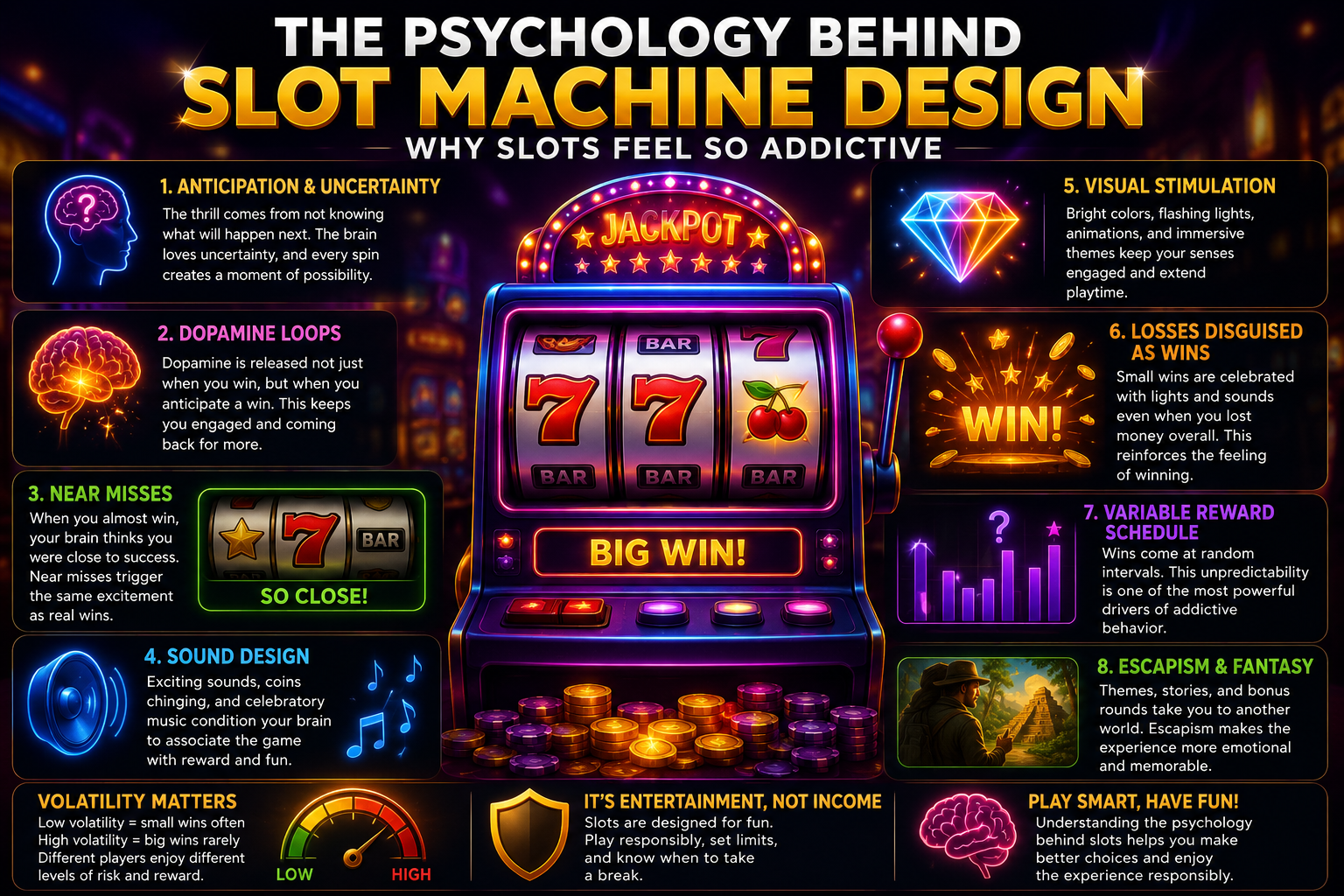
Human beings are naturally fascinated by uncertainty. The brain reacts strongly to situations where a reward might happen, but is not guaranteed. Interestingly, psychological studies have repeatedly shown that uncertain rewards can sometimes create even stronger behavioural engagement than guaranteed rewards.

This is one reason slots feel so compelling.

Every spin creates a moment of possibility.

Even before the reels stop spinning, the player’s brain begins imagining potential outcomes. Will the bonus land? Will the jackpot hit? Will the final scatter symbol appear? That brief period between pressing spin and seeing the outcome creates a surge of anticipation that becomes psychologically rewarding in itself.

The brain starts associating the spinning process with excitement and possibility long before any actual win occurs.

This effect becomes even stronger because slot machines operate on what psychologists call variable reward schedules.

Unlike predictable reward systems, where outcomes occur consistently, slots deliver wins at irregular and unpredictable intervals. Sometimes players win quickly. Sometimes nothing happens for dozens of spins. Occasionally, a huge feature suddenly appears unexpectedly.

This randomness keeps the brain highly engaged because it continuously searches for patterns and reward opportunities.

It is similar to why social media notifications, viral videos, and smartphone scrolling can feel difficult to stop. The uncertainty itself becomes stimulating.

Dopamine also plays a major role.

Dopamine is often misunderstood as simply a “pleasure chemical,” but in reality, it is heavily involved in motivation, anticipation, learning, and reward-seeking behaviour. The brain releases dopamine not only when rewards happen, but also when rewards might happen.

This distinction is extremely important in slot machine psychology.

The anticipation of a possible reward can become just as neurologically stimulating as the reward itself.

That is why near misses feel so emotionally powerful.

A near miss occurs when the slot appears to come extremely close to a large win or bonus feature. Perhaps two jackpot symbols land, and the third just barely misses. Or the final scatter appears one position above the payline.

Objectively, a near miss is still a loss.

Psychologically, however, the brain often interprets it differently.

Near misses create the feeling that success was “almost achieved,” which can increase excitement and motivate continued play rather than discouraging it. Some studies suggest near misses activate similar reward-related areas of the brain as actual wins.

This is one reason slot sessions can become emotionally intense very quickly.

Sound design is another massively underestimated part of slot machine psychology.

Modern slots are filled with carefully engineered audio systems designed to reinforce emotional responses continuously throughout gameplay.

Winning sounds are especially important.

Even small wins are often accompanied by celebratory noises, rising musical tones, coins dropping, explosions of sound, or triumphant melodies. The audio creates the emotional impression that something significant has happened, even when the actual payout may be relatively modest.

The brain begins associating these sounds with reward and excitement.

This conditioning effect becomes extremely powerful over time.

Casinos discovered years ago that removing sound dramatically reduced player engagement because the emotional stimulation decreased immediately. Silent slot machines feel surprisingly flat compared to modern audio-rich experiences.

Visual design operates similarly.

Bright colours, flashing animations, dynamic movement, cinematic bonus rounds, particle effects, expanding reels, multipliers, and immersive themes all contribute to continuous sensory stimulation.

Modern slots increasingly resemble video games more than traditional gambling machines.

Developers now employ designers, animators, musicians, storytellers, behavioural analysts, and user-experience specialists to maximise immersion and emotional engagement.

Themes matter enormously, too.

Ancient Egypt, mythology, fantasy worlds, adventure stories, music, movies, branded franchises, Vegas glamour, treasure hunts, anime aesthetics, cyberpunk visuals, and luxury imagery all tap into different emotional identities and escapism triggers.

Players are not only spinning reels.

They are entering temporary fantasy environments designed to feel exciting and emotionally rewarding.

Another major psychological factor involves “losses disguised as wins.”

This occurs when the slot celebrates a payout that is technically smaller than the original wager.

For example, a player may bet £1 and receive a 40p payout accompanied by flashing lights, celebratory sounds, and visual excitement. Financially, the player still lost 60p overall. Emotionally, however, the brain partially registers the event as rewarding because of the sensory reinforcement surrounding it.

Over time, this can distort how players emotionally perceive outcomes.

Volatility mechanics also influence player psychology heavily.

Low-volatility slots produce smaller, more frequent wins. High-volatility slots produce longer losing streaks interrupted by occasional large payouts.

Different players respond differently to these systems.

Some enjoy steady reinforcement and longer play sessions. Others chase the emotional intensity of massive bonus potential and explosive jackpots.

Interestingly, high-volatility slots often create stronger emotional attachment because rare large wins feel more memorable psychologically than many small rewards.

This ties into another major behavioural factor: intermittent reinforcement.

Intermittent rewards are famously powerful in behavioural psychology because they encourage persistence. If outcomes were completely predictable, people would lose interest quickly. But uncertainty keeps the brain engaged continuously.

This principle exists far beyond gambling.

It appears in social media algorithms, dating apps, video games, smartphone notifications, and many digital engagement systems throughout modern technology.

Slots simply apply these principles in highly concentrated form.

Modern online casinos have also become exceptionally skilled at reducing friction.

Years ago, gambling involved physical cash, travelling to casinos, exchanging chips, and physically handling money. Today, deposits happen instantly through Apple Pay, debit cards, e-wallets, open banking systems, and mobile apps.

The easier the experience becomes, the more psychologically seamless the engagement loop feels.

This is one reason mobile slots became so dominant.

A casino now effectively lives inside a smartphone, accessible instantly at any moment.

Streaming technology and live casino systems have intensified immersion even further. Live dealer environments create social realism, authenticity, and emotional atmosphere that traditional digital gambling lacked years ago.

Meanwhile, slot design itself increasingly incorporates gamification systems borrowed directly from video games.

Progress bars, unlockable features, tournaments, missions, daily rewards, level systems, loyalty mechanics, and achievement structures all encourage longer engagement sessions.

Again, this does not necessarily make slots inherently unethical.

Many people play responsibly for entertainment in the same way others enjoy films, sports betting, gaming, or other recreational experiences.

The key issue is understanding how psychologically sophisticated modern gambling products have become.

The industry is no longer simply about spinning mechanical reels.

It is now deeply connected to behavioural science, neuroscience, data analytics, UX optimisation, emotional design, mobile technology, and digital retention systems.

Artificial intelligence is likely to accelerate this even further.

Future slot systems may eventually personalise pacing, themes, bonus structures, volatility recommendations, and engagement systems dynamically based on player behaviour patterns in real time.

That possibility raises increasingly important conversations around ethics, regulation, consumer protection, and responsible gambling frameworks.

The UK, in particular, has become one of the world’s strictest gambling regulatory environments precisely because regulators increasingly recognise how psychologically advanced digital gambling systems have become.

Features involving autoplay, bonus buy mechanics, spin speeds, financial vulnerability monitoring, affordability checks, and advertising standards have all faced growing scrutiny in recent years.

Ultimately, the psychology behind slot machine design explains something very important:

People are not only responding to the possibility of money.

They are responding to anticipation, stimulation, escapism, immersion, uncertainty, emotional reinforcement, and reward expectation systems deeply connected to human behaviour itself.

That is why slots remain so globally successful.

They are not just games of chance.

They are highly engineered emotional experiences built around the psychology of anticipation and possibility.

Where to Next:

Where can I find casinos with low wagering requirements on bonuses?

UK Casinos With Low or No Wagering Requirements On Bonuses?

Find Them Right Here UK Casinos With Low or No Wagering Requirements On Bonuses? If you’ve ever signed up to an online casino, claimed a bonus, hit a win, and then realised you couldn’t actually withdraw it, you already understand why this topic matters so much. Wagering requirements have long been the hidden barrier between

Read More »
Best Online Casinos for UK Players With Fast Payouts (2026 Guide)

Best Online Casinos for UK Players With Fast Payouts (2026 Guide)

See UK Casinos Best Online Casinos for UK Players With Fast Payouts (2026 Guide) When it comes to choosing the best online casinos for UK players, fast payouts are no longer a luxury—they’re an expectation. In a regulated market overseen by the UK Gambling Commission, players rightly demand not just security and fairness, but speed,

Read More »
Vegas jackpot excitement with no wagering.png

Best No Wagering Casino Bonuses In The UK (April 2026)

No Wagering Keep What You Win Bonuses in the UK: The Complete 2026 Player Guide For players actively searching for no wagering keep what you win bonuses in the UK, the objective is no longer just finding a bonus—it is finding a bonus that actually delivers real value without unnecessary complications. The shift in player behaviour

Read More »

FAQ: Slot Machine Psychology and Why Slots Feel Addictive

1. Why do slot machines feel so addictive?

Slot machines are specifically designed to maximise engagement, anticipation, excitement, and emotional stimulation. They combine lights, sounds, movement, rewards, unpredictability, and immersive design into one continuous experience.

The brain reacts strongly to uncertain rewards, and slots constantly create situations where a win might happen at any moment. That uncertainty keeps players emotionally engaged because anticipation itself becomes stimulating.

Modern slots are not simply gambling products anymore. They are highly engineered digital entertainment systems built around behavioural psychology.

2. Are slot machines designed using psychology?

Yes.

Modern slot developers heavily use behavioural psychology, neuroscience principles, user-experience design, sound engineering, and visual stimulation techniques to increase player engagement.

This does not necessarily mean games are unfair or rigged, but it does mean enormous effort goes into understanding how people emotionally respond to gambling environments.

3. What role does dopamine play in slot machines?

Dopamine is heavily connected to motivation, reward anticipation, learning, and excitement.

Many people incorrectly think dopamine only appears after winning money. In reality, dopamine often spikes before the outcome occurs because the brain becomes excited by the possibility of reward.

This means the anticipation of spinning the reels itself can become psychologically stimulating even before any win happens.

4. Why do near misses feel so powerful?

A near miss occurs when the slot appears to come extremely close to a bonus or jackpot.

Examples include:

two jackpot symbols landing while the third narrowly misses,

or one scatter symbol stopping just above the payline.

Even though the player technically loses, the brain often interprets near misses differently from normal losses because success feels “almost achieved.”

This creates emotional tension and can encourage continued play.

5. Are slot machines random?

Regulated slot machines use Random Number Generator systems, commonly called RNGs.

These systems generate outcomes randomly over time. Each spin operates independently.

However, while the outcomes themselves are random, the surrounding experience — sounds, visuals, animations, timing, and presentation — is carefully designed psychologically.

6. Why do slots use flashing lights and bright colours?

Visual stimulation keeps the brain engaged.

Bright colours, animations, explosions, multipliers, expanding reels, and cinematic effects all increase emotional intensity and sensory immersion.

Modern slots increasingly resemble video games because developers want gameplay to feel exciting continuously, even during losing sessions.

7. Why are slot machine sounds so important?

Sound is one of the most powerful emotional reinforcement tools in gambling design.

Winning sounds trigger emotional excitement and condition the brain to associate gameplay with reward.

Even small wins often produce exaggerated celebratory noises because the sound itself helps maintain positive emotional engagement.

Without sound, slots generally feel far less exciting.

8. What are “losses disguised as wins”?

This happens when a slot celebrates a payout that is technically smaller than the original wager.

For example:

a player bets £1,

wins 40p,

but the machine still produces celebratory animations and sounds.

Financially, the player lost money overall. Emotionally, however, the brain partially interprets the event as rewarding because of the sensory celebration surrounding it.

9. Why do players keep spinning after losing?

Several psychological systems combine together:

anticipation,

hope,

near misses,

variable rewards,

emotional momentum,

and dopamine anticipation.

The brain becomes focused on the possibility that the next spin could completely change the session.

10. What is a variable reward schedule?

Variable rewards occur unpredictably rather than consistently.

Sometimes players win quickly.

Sometimes long losing streaks occur.

Occasionally large wins appear unexpectedly.

Psychologists have long known that unpredictable rewards create stronger behavioural engagement than fixed predictable rewards.

11. Is slot machine psychology similar to social media psychology?

Very much so.

Both systems rely heavily on:

anticipation,

unpredictability,

dopamine loops,

intermittent rewards,

and continuous engagement systems.

This is why scrolling social media feeds and spinning slot reels can trigger surprisingly similar behavioural patterns.

12. Why do some slots feel more exciting than others?

Different slots use different combinations of:

volatility,

sound design,

visual pacing,

bonus frequency,

themes,

animation intensity,

and reward structures.

Some players prefer slower steady gameplay while others prefer extremely high-volatility games with massive jackpot potential.

13. What is slot volatility?

Volatility refers to how risk and rewards are distributed over time.

Low-volatility slots usually produce:

smaller wins,

more frequent payouts,

and longer play sessions.

High-volatility slots usually produce:

larger jackpots,

longer losing streaks,

and more emotionally intense gameplay.

14. Why are high-volatility slots so popular?

Large rare wins create stronger emotional memories than frequent small wins.

Big bonus rounds and huge multipliers generate excitement, suspense, and fantasy potential that many players find emotionally thrilling.

The possibility of a life-changing hit becomes psychologically powerful.

15. Why do slot themes matter so much?

Themes create emotional immersion.

Ancient Egypt,

fantasy worlds,

Vegas glamour,

pirates,

movies,

music,

cyberpunk,

adventure stories,

luxury lifestyles,

and mythology all trigger different emotional responses and escapism fantasies.

Players often connect emotionally to themes before they even understand the game mechanics.

16. Are mobile slots more addictive than older casino machines?

Mobile access increases convenience dramatically.

Years ago, visiting a casino required physical effort and planning.

Now a slot game exists inside a smartphone accessible instantly anywhere.

This reduction in friction can increase session frequency and accessibility significantly.

17. Why do online casinos use loyalty systems and rewards?

Gamification systems encourage continued engagement.

These systems include:

daily rewards,

missions,

leaderboards,

tournaments,

VIP systems,

achievement badges,

and progression mechanics.

Many of these systems originate directly from video game design psychology.

18. Why do players chase losses?

Loss chasing often happens because people emotionally believe they can recover previous losses through continued play.

Psychologically, losses feel emotionally painful, and the brain naturally seeks resolution.

Unfortunately, emotional decision-making during gambling sessions often increases risk rather than reducing it.

19. Can slots create emotional attachment?

Yes.

Players often develop attachment to:

specific games,

bonus rounds,

themes,

soundtracks,

favourite symbols,

or memorable winning experiences.

Emotional familiarity can become very powerful over time.

20. Why do jackpots attract so much attention?

Huge jackpots activate fantasy thinking.

Even small chances of massive rewards create strong emotional engagement because the brain naturally imagines life-changing outcomes.

Progressive jackpots especially amplify this effect because the numbers constantly grow visibly in real time.

21. Do casinos intentionally try to keep players playing longer?

Modern gambling systems are heavily optimised around engagement and session duration.

Developers continuously study:

player behaviour,

retention patterns,

session length,

bonus pacing,

and emotional reactions.

The goal is usually to maximise entertainment engagement while remaining commercially profitable.

22. Why do slot machines sometimes feel hypnotic?

Slots create repetitive sensory loops involving:

movement,

music,

anticipation,

visual rhythm,

button pressing,

and emotional pacing.

Over time, some players enter highly focused repetitive mental states where outside distractions temporarily fade.

23. Are some people more vulnerable to slot addiction than others?

Yes.

Factors such as:

personality,

mental health,

stress,

financial pressure,

dopamine sensitivity,

impulsivity,

and emotional coping patterns can all influence gambling vulnerability.

Not everybody responds to gambling systems in the same way.

24. Why are regulators becoming stricter around online slots?

Governments increasingly recognise how psychologically advanced digital gambling products have become.

Regulators now examine issues involving:

spin speed,

autoplay,

bonus mechanics,

advertising,

financial vulnerability,

affordability,

and behavioural harm more closely than ever before.

25. What is responsible gambling?

Responsible gambling means treating gambling as entertainment rather than financial strategy.

Key principles include:

setting limits,

never chasing losses,

taking breaks,

gambling only with affordable money,

and understanding that outcomes remain random over time.

26. Can understanding slot psychology help players?

Yes.

Understanding how anticipation, sound, visuals, near misses, and emotional reinforcement work can help players make more conscious decisions and recognise behavioural triggers more clearly.

Awareness often improves self-control.

27. Are slot developers becoming more sophisticated technologically?

Absolutely.

Modern slot development now involves:

behavioural analytics,

AI systems,

UX design,

advanced animation,

real-time player data,

streaming technology,

and mobile optimisation.

The industry increasingly resembles advanced entertainment software development.

28. Could AI change slot machine psychology further?

Very likely.

Future systems may eventually personalise gameplay dynamically based on individual behaviour patterns, pacing preferences, volatility tolerance, or engagement history.

This possibility creates growing ethical and regulatory debate.

29. Why do people continue playing slots even when they know the odds?

Because gambling is not driven purely by logic.

People respond emotionally to:

hope,

escapism,

excitement,

anticipation,

fantasy,

social identity,

and entertainment value.

The emotional experience itself often becomes part of the attraction.

30. What is the single biggest psychological reason slots remain so popular globally?

The most powerful factor is anticipation.

Every spin creates the emotional possibility that something exciting could happen next.

That uncertainty — combined with lights, sounds, immersion, near misses, reward systems, and fantasy potential — creates one of the most psychologically engaging entertainment experiences ever designed.